


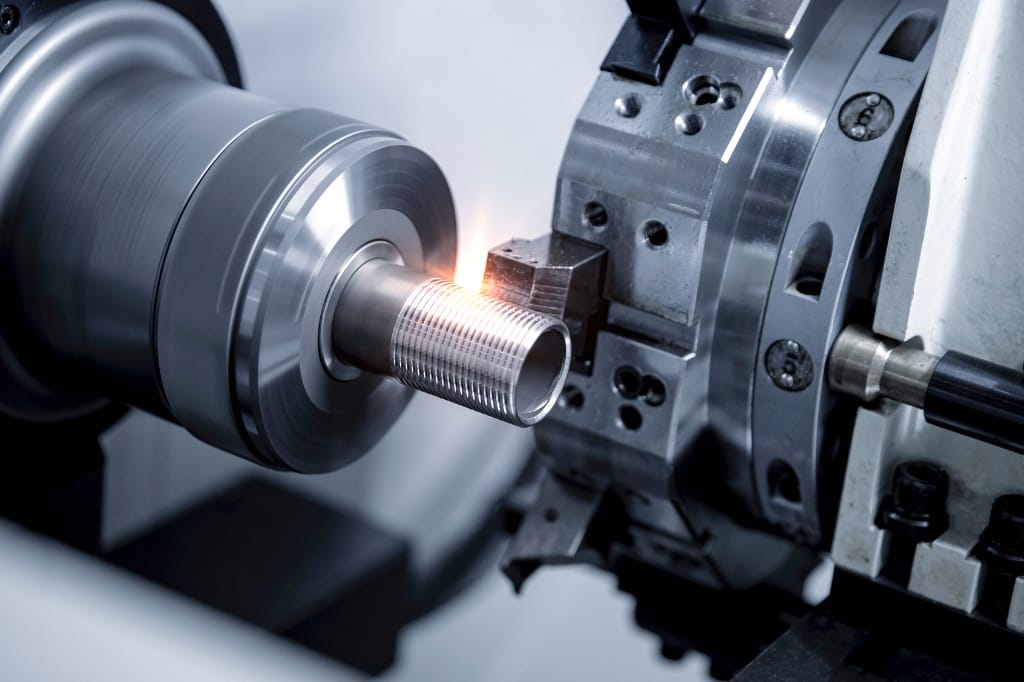
CNC machines, or Computer Numerical Control machines, are automated tools used to manufacture precise parts by following programmed instructions. These machines are essential in industries like aerospace, automotive, and manufacturing due to their ability to produce complex designs with accuracy.
There are many CNC machine types, each designed for specific tasks like cutting, drilling, milling, or grinding. Different type of CNC machines offer unique capabilities, making them suitable for various applications. In this article, we’ll explore the different types of CNC machines and their uses. At Yijin Hardware, we specialize in providing top-quality CNC machining services tailored to your needs.
Key Takeaways
- CNC machines are categorized by function and axis configuration, with each type — such as milling, lathes, routers, plasma cutters, and laser cutters — tailored for specific manufacturing tasks and material types.
- Advanced CNC systems like EDM, waterjet cutters, and 3D printers expand capabilities for precision, heat-sensitive, or complex geometries that traditional subtractive machines cannot easily achieve.
- Selecting the right CNC machine depends on factors like material type, part complexity, production scale, and budget, making it essential to match machine capabilities to project requirements.
What are the Different Types of CNC Machines?
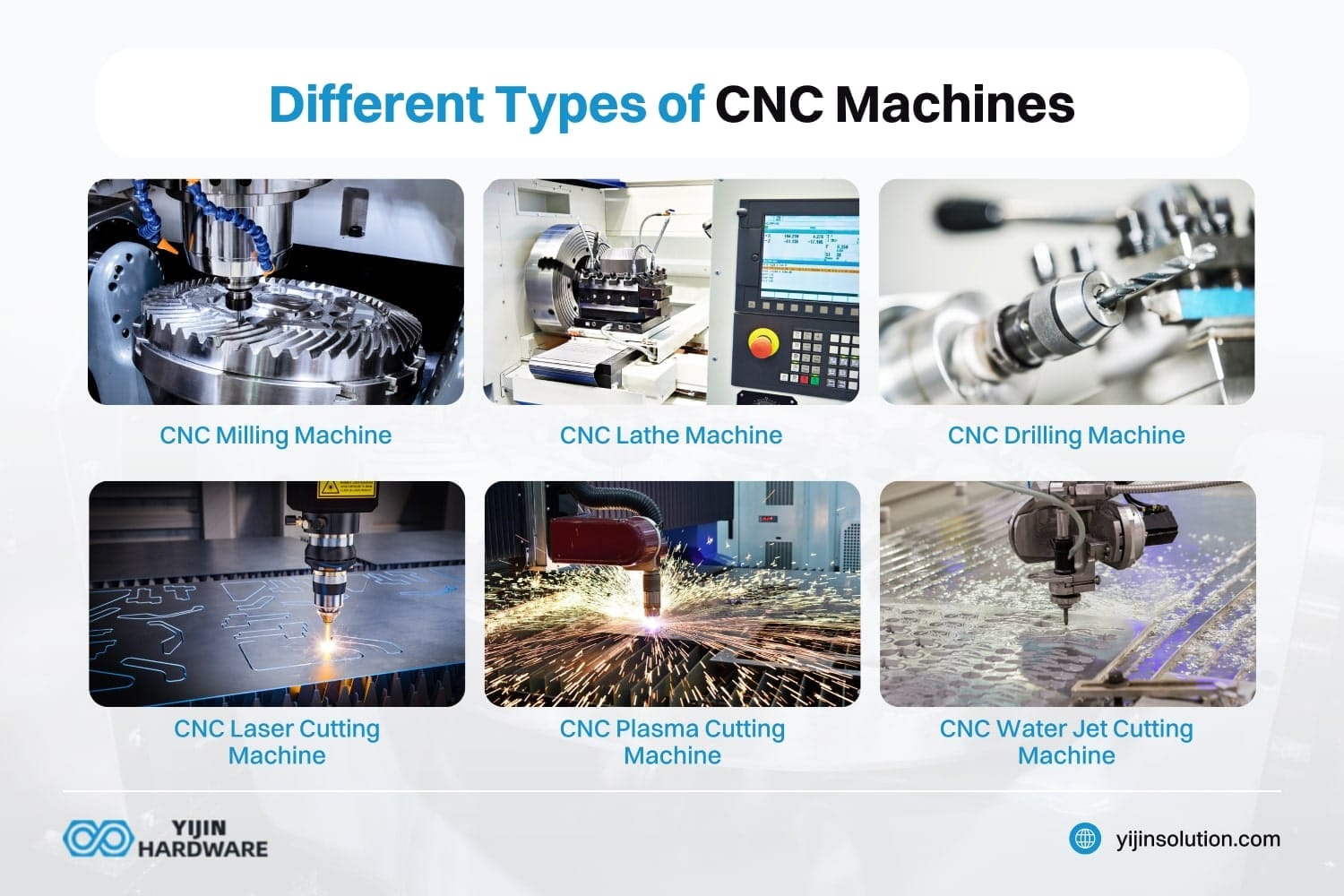
Different Type of CNC Machines include CNC milling machines, lathes, routers, plasma cutters, and laser cutters. CNC machines are categorized by their functions and the number of axes they operate on. Each type of CNC machine is designed for specific tasks such as cutting, drilling, or shaping materials.
For example, 2-axis CNC machines handle basic operations like straight-line cuts, while 3-axis CNC machines can create more complex parts by adding depth control. Let’s cover all the different types of CNC machines right here:
1. What are CNC Milling Machines?
CNC milling machines are versatile subtractive manufacturing tools that use rotating cutting tools to remove material from a stationary workpiece. The cutting tool moves in multiple directions to create complex three-dimensional shapes with high precision.
| CNC Machine Type | Description | Primary Applications |
|---|---|---|
| Milling Machine | Removes material using rotating cutting tools on a stationary workpiece to create complex 3D shapes with high precision. |
|
According to Goodwin University, CNC milling machines come in several varieties, including hand, plain, universal, and omniversal types. They can achieve tolerances as tight as ±0.005 mm and create complex 3D geometries from metals, plastics, and composites.
2. What are CNC Lathes?
CNC lathes, also called turning centers, rotate the workpiece around a central axis while stationary cutting tools remove material to create cylindrical components.
| CNC Machine Type | Description | Primary Applications |
|---|---|---|
| Lathe | Rotates the workpiece while stationary cutting tools remove material to create cylindrical parts with excellent concentricity |
|
This process is ideal for creating parts with rotational symmetry. These machines rotate workpieces at speeds of 50-5,000 RPM while stationary cutting tools remove material to create cylindrical parts. They achieve concentricity within 0.005 mm and surface finishes as fine as Ra 0.8μm.
3. What are CNC Routers?
CNC routers are cutting machines similar to milling machines but with designs optimized for processing larger, flatter workpieces and softer materials.
| CNC Machine Type | Description | Primary Applications |
|---|---|---|
| Router | Similar to mills but with larger work areas and higher speeds, designed primarily for wood, plastic, and soft metals. |
|
They feature a gantry structure with the cutting head moving over a stationary workpiece on a flat table. These machines feature larger work areas (up to 5×10 feet or larger) and higher travel speeds than traditional mills. While less rigid than mills (typical tolerance ±0.025-0.1 mm), they offer excellent value for panel processing, signage, furniture components, and architectural elements.
4. What are CNC Plasma Cutting Machines?
CNC plasma cutting machines use a superheated, electrically conductive gas (plasma) to cut through metal sheets and plates.
| CNC Machine Type | Description | Primary Applications |
|---|---|---|
| Plasma Cutter | Uses electrically ionized gas (plasma) at extreme temperatures to cut through conductive metals with high speed. |
|
The plasma arc melts the material, while a high-pressure gas jet blows the molten metal away to create the cut. These systems heat plasma to 20,000-30,000 °C to cut through electrically conductive materials.
These machines cut steel up to 150 mm thick at speeds up to 500 inches per minute, though with moderate precision (tolerance ±0.5 mm). They are popular in metal fabrication industries as CNC plasma cutting machines offer high precision and speed.
5. What are CNC Laser Cutting Machines?
CNC laser cutting machines use a highly focused beam of light to cut, engrave, or mark materials with exceptional precision.
| CNC Machine Type | Description | Primary Applications |
|---|---|---|
| Laser Cutter | Utilizes a focused laser beam to cut or engrave materials with exceptional precision and minimal material distortion. |
|
The laser beam’s intense energy melts, burns, or vaporizes the material in a controlled manner to create precise cuts and detailed features. These machines utilize focused laser beams with power densities up to 10^6 watts/cm² to process various materials.
However, laser cutting machines are limited by maximum material thickness (typically 25 mm for metals) and reflective material challenges. CNC laser cutting machines are versatile tools in modern manufacturing.
6. What are CNC Grinding Machines?
CNC grinding machines use abrasive wheels to remove material and create extremely precise surfaces and dimensions.
| CNC Machine Type | Description | Primary Applications |
|---|---|---|
| Grinding Machine | Uses abrasive wheels to achieve superior surface finishes and tight tolerances, especially on hardened materials. |
|
Unlike other cutting methods, grinding can process hardened materials and achieve superior surface finishes through controlled abrasion. These precision machines use abrasive wheels rotating at 500-3,600 RPM to remove small amounts of material (0.0025-0.075 mm per pass) with exceptional precision.
They achieve surface finishes as fine as Ra 0.1μm and dimensional tolerances as tight as ±0.0025 mm. They’re essential for processing hardened materials (HRC 70+) in automotive (crankshafts, camshafts), aerospace (turbine components), and tool & die industries.
7. What are CNC Electrical Discharge Machines (EDM)?
CNC EDM machines use controlled electrical sparks to erode conductive materials in a dielectric fluid.
| CNC Machine Type | Description | Primary Applications |
|---|---|---|
| Electrical Discharge Machine (EDM) | Removes material using electrical sparks to erode conductive materials, effective on hardened metals with complex shapes. |
|
This non-contact machining process can create complex shapes in extremely hard materials, even after heat treatment, with no cutting forces applied to the workpiece.
The three main types are wire EDM (using thin wire for precise cuts, ±0.003 mm tolerance), sinker/ram EDM (shaped electrodes for cavities), and hole-drilling EDM (for small, deep holes).
8. What is a Waterjet Cutting Machine?
CNC waterjet cutting machines use an ultra-high-pressure stream of water, often mixed with abrasive particles, to cut through materials.
| CNC Machine Type | Description | Primary Applications |
|---|---|---|
| Waterjet Cutting Machine | Cuts materials using ultra-high-pressure water, often mixed with abrasive particles, with no heat-affected zone. |
|
This cold-cutting process can cut virtually any material without heat-affected zones, making it ideal for heat-sensitive applications. These systems force water through a small orifice (0.1-0.4 mm) at extreme pressures (40,000-90,000 PSI). Pure waterjets cut soft materials (rubber, foam, food), while abrasive waterjets add garnet particles to cut harder materials including metals, stone, and ceramics up to 200 mm thick.
They create no heat-affected zone but operate more slowly than thermal methods with typical tolerances of ±0.075 mm.
9. What are Pick and Place Machines?
Pick and place machines are specialized CNC systems designed for electronics manufacturing. They automatically pick up electronic components from feeders and precisely place them onto printed circuit boards (PCBs) before soldering.
| CNC Machine Type | Description | Primary Applications |
|---|---|---|
| Pick and Place Machine | Automates the placement of electronic components onto circuit boards with high speed and precision. |
|
These machines use vacuum nozzles mounted on high-speed positioning systems to handle electronic components with high precision. Modern systems incorporate machine vision for alignment accuracy to ±0.025 mm and can place 10,000-100,000 components per hour.
Essential for manufacturing smartphones, computers, automotive electronics, and medical devices. They dramatically reduce assembly errors compared to manual placement and can handle components as small as 0.4 × 0.2 mm.
10. What is a 3D Printer?
CNC 3D printers build parts layer by layer from the bottom up using additive manufacturing techniques.
| CNC Machine Type | Description | Primary Applications |
|---|---|---|
| 3D Printer | Builds parts layer by layer using additive manufacturing techniques rather than removing material. |
|
While traditional CNC machines subtract material, 3D printers add material precisely according to a digital model to create complex three-dimensional objects. These machines build parts layer by layer with thicknesses from 0.025 mm to 0.3 mm.
While slower than subtractive methods, they can create complex internal geometries impossible with traditional manufacturing and require no tooling, making them economical for prototyping and low-volume production.
11. What is a Machine with Automatic Tool Changer?
CNC machines with Automatic Tool Changers are advanced manufacturing systems that can automatically swap cutting tools during operation without manual intervention.
| CNC Machine Type | Description | Primary Applications |
|---|---|---|
| Machine with Automatic Tool Changer | Features systems that automatically switch cutting tools during operation without manual intervention. |
|
This capability allows complex parts requiring multiple tools to be manufactured in a single setup with minimal downtime. These sophisticated systems automatically switch cutting tools during operation, with the entire exchange taking just 2–10 seconds. Tool magazines or carousels hold 10–200 tools ready for use.
Configurations include carousel-type (8-24 tools), chain-type (30-200 tools), rack-type (for larger tools), and matrix ATC (maximum capacity in minimal space). This capability reduces setup time, ensures consistent tool positioning, and enables complex parts requiring multiple tools to be completed in a single setup.
12. What is a Drilling Machine?
CNC drilling machines are specialized for creating precise holes in materials with high efficiency and accuracy.
| CNC Machine Type | Description | Primary Applications |
|---|---|---|
| Drilling Machine | Specialized for creating precise holes in materials with high efficiency and positional accuracy. |
|
They use rotating drill bits to create holes of various diameters and depths according to programmed instructions. These machines utilize drill bits from 0.1 mm to 50 mm in diameter and can achieve positional accuracy of ±0.01 mm.
Used extensively in PCB manufacturing (creating thousands of holes in a single board), aerospace (airframe components), automotive (engine blocks), and oil & gas industries (precision components for downhole equipment).
How do you Choose the Best Type of CNC Machine?
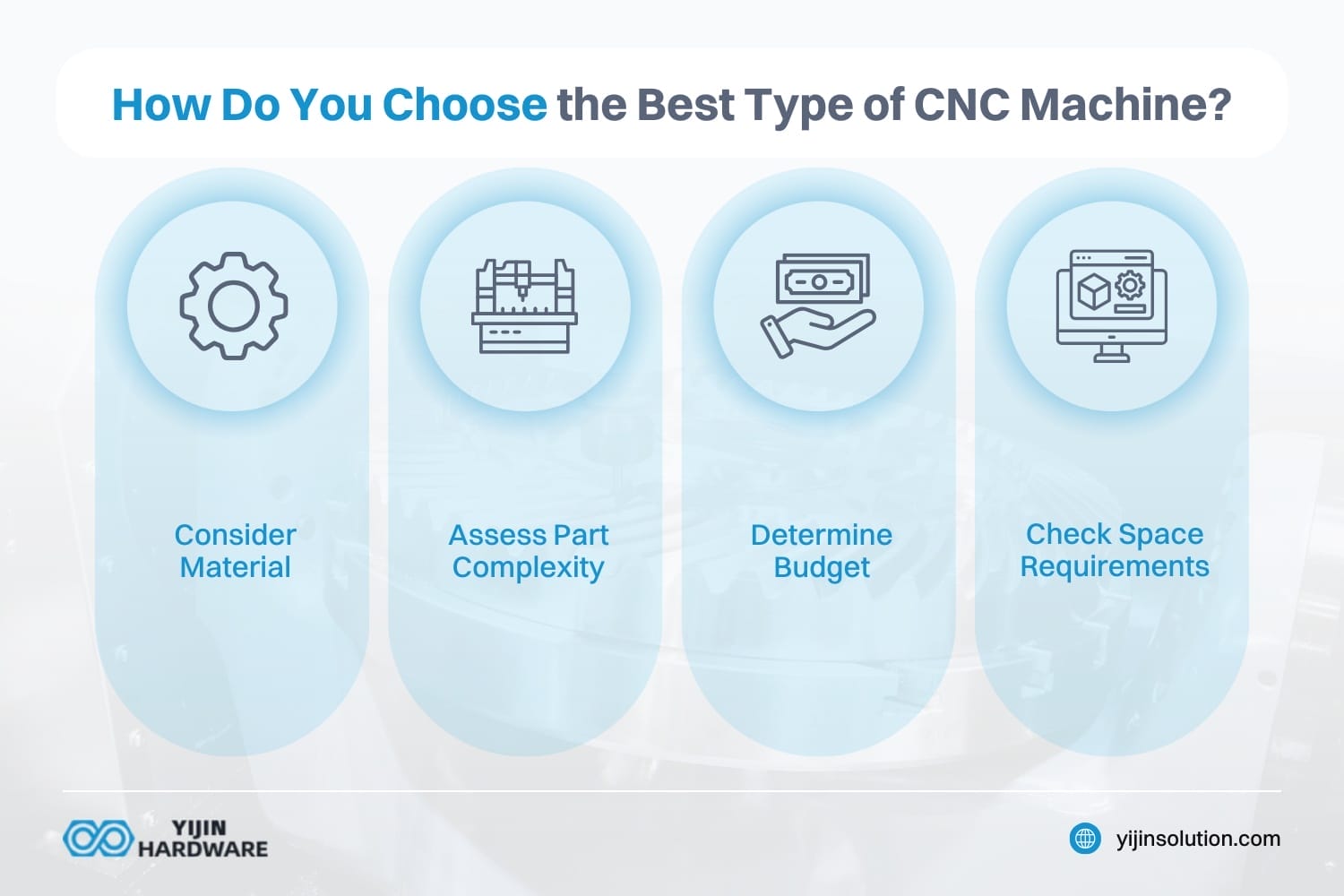
Choosing the right CNC machine depends on your production needs and budget. Start by considering the materials you will work with, as different machines specialize in metals, plastics, or wood. Here are some tips to help you pick the best type of CNC machine:
- Consider the material you’ll be working with (e.g., wood vs. metal)
- Assess the complexity of the parts you need (e.g., simple vs. intricate)
- Determine your budget (e.g., entry-level vs. industrial-grade)
- Evaluate space requirements (e.g., compact vs. large-scale equipment)
When selecting a CNC machine, also consider factors like the number of axes, cutting tools, and control systems. Different Type of CNC Machines offer various capabilities, so it’s important to match the machine to your specific requirements.
Yijin Hardware: CNC Machining Services You Can Trust
At Yijin Hardware, we provide reliable CNC machining services tailored to meet your specific needs. Our expertise covers all types of CNC machines, ensuring precision and quality in every project we handle. Whether you need prototypes or large-scale production runs, our team is ready to assist you. Contact us today to learn more about our services!
CNC Machines Types FAQs
What are the different types of CNC drilling machines?
There are various types of CNC drilling machines, such as vertical, horizontal, and radial drill machines. These CNC types are selected based on the type of material and the precision required. A CNC system allows for accurate drilling with minimal operator input, increasing efficiency in production. CNC drilling machines are ideal for industries requiring high-volume drilling and precision, such as automotive or aerospace.
What are the different types of CNC grinding machines?
CNC grinding machines include surface grinders, cylindrical grinders, and centerless grinders, each serving specific purposes. Surface grinders are used for fine surface finishes, while cylindrical grinders handle round, cylindrical parts. Centerless grinders are used for grinding parts without requiring centers to hold the workpiece. Different Type of CNC Machines based on grinding functions offer various options for precision machining of metal parts.
What are the different types of CNC laser cutting machines?
CNC laser cutting machines are categorized into CO2 laser cutting machines, fiber laser machines, and hybrid machines. CO2 laser cutters are used for cutting non-metal materials, while fiber laser machines are best for metals. The popular CNC hybrid machines combine the benefits of both, enabling versatile cutting of various materials with precision. Selecting the best CNC machine type depends on the material and thickness being processed.
What are the different types of CNC lathe machines?
CNC lathe machines come in types such as turning machines, multi-axis machines, and 5-axis CNC machines. CNC equipment turning machines are ideal for cylindrical parts, while multi-axis machines provide more complex and detailed machining operations. A 5-axis CNC machine offers high precision for complex geometries and intricate shapes. Types of CNC machining systems based on lathe functions differ by the level of complexity required for the machine tool.
Back to Top: What are the Different Types of CNC Machines?




 EN
EN  ES
ES  RU
RU  DE
DE  FR
FR