


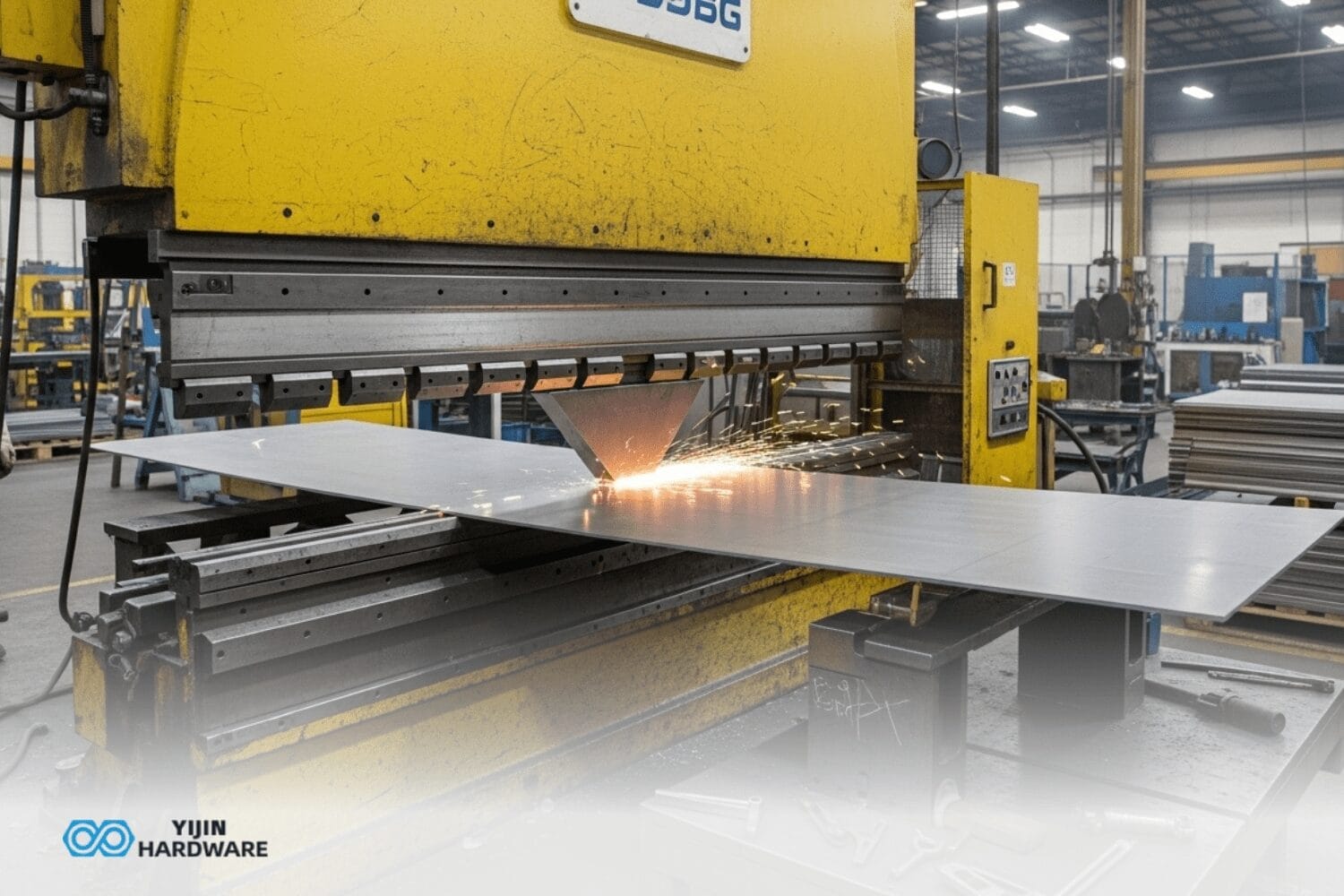
Sheet metal bending is one of those manufacturing processes you probably don’t think about—until you realize it’s everywhere. Your car’s chassis, the electronics housing on your desk, aircraft components, even the brackets holding up your shelves—they all started as flat metal sheets that got bent into shape.
If you’re looking into metal fabrication for a project, understanding how bending works matters. It’s not just about folding metal; it’s about precision, repeatability, and getting parts that actually fit together properly. The difference between amateur work and professional sheet metal bending shows up in tolerances measured in fractions of a millimeter.
This guide breaks down what actually happens during the bending process, the different types of bends you can create, and why modern CNC bending techniques have completely changed what’s possible in sheet metal fabrication. Let’s get into it.
Key Takeaways
- Sheet metal bending shapes flat metal into specific bend angles using various techniques tailored to the part requirements
- CNC bending technology dramatically improves precision and efficiency whilst reducing errors in metal fabrication
- Successful bending requires careful consideration of bend radii, metal thickness, and material properties to avoid cracking or distortion
- Air bending and press brake techniques are among the most commonly used sheet metal bending processes in modern fabrication
- Yijin Hardware’s advanced sheet metal bending and forming methods ensure accuracy and consistency for every bent sheet metal part we produce
What is Bending Sheet Metal?
Bending sheet metal is the process of deforming a metal sheet along a straight axis to create an angle or curve. By applying a controlled force, the metal is bent without breaking, making it a versatile and cost-effective method for shaping sheet metals in manufacturing. This process allows us to form sheet metal parts used in a wide range of applications, from structural components in construction to precise parts for electronics.
What are the Types of Sheet Metal Bending?
There are various types of sheet metal bending techniques, each tailored for different applications:
- V-Bending: This technique uses a punch and die to create V-shaped bends, commonly used in industries like automotive.
- U-Bending: U-bending is used to create deeper, more complex bends for applications that require large radius bends.
- Air Bending: Air bending uses minimal contact between the tool and metal sheet to create bends with moderate precision, ideal for thin sheet metal.
- Coining: This metal bending method uses high pressure to create tight bends, perfect for complex sheet metal bending with very high precision.
- Roll Bending: This technique uses rollers to form curves, ideal for creating large radii or cylindrical shapes, such as pipes.
| Bending Method | Primary Use | Precision | Material Suitability |
|---|---|---|---|
| V-Bending | General Bending | High | Steel, Aluminum, Copper |
| U-Bending | Deep Channels | Moderate | Steel, Aluminum |
| Air Bending | Versatile | Moderate | Thin Sheets, Mild Steel |
| Coining | Precision | Very High | Stainless Steel, Hard Metals |
| Roll Bending | Large Radius | Moderate | Various Metals |
How does the Sheet Metal Bending Process Work?
In sheet metal bending, a bending machine applies a controlled bending force to deform a metal sheet around a tool. The process typically involves placing the metal sheet between a punch and die, with the punch applying force to create the desired bend angle. Depending on the sheet thickness, bend radii, and material type, the right bending method is chosen. Yijin Hardware uses advanced CNC bending to ensure precision, especially in complex sheet metal bending tasks.
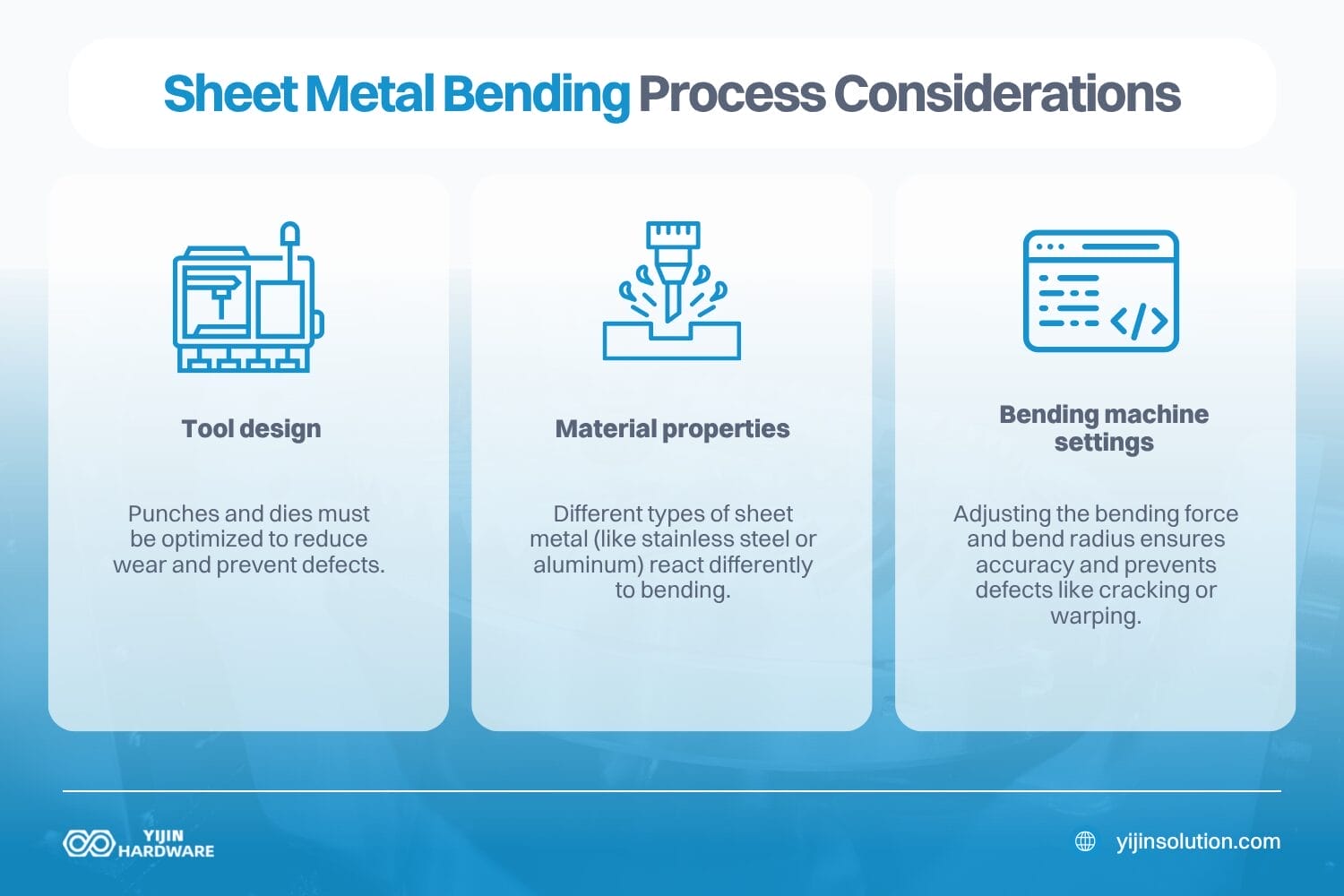
The process of bending requires careful consideration of:
- Tool design: Punches and dies must be optimized to reduce wear and prevent defects.
- Material properties: Different types of sheet metal (like stainless steel or aluminum) react differently to bending.
- Bending machine settings: Adjusting the bending force and bend radius ensures accuracy and prevents defects like cracking or warping.
What Materials are Used for Bending Sheet Metal?
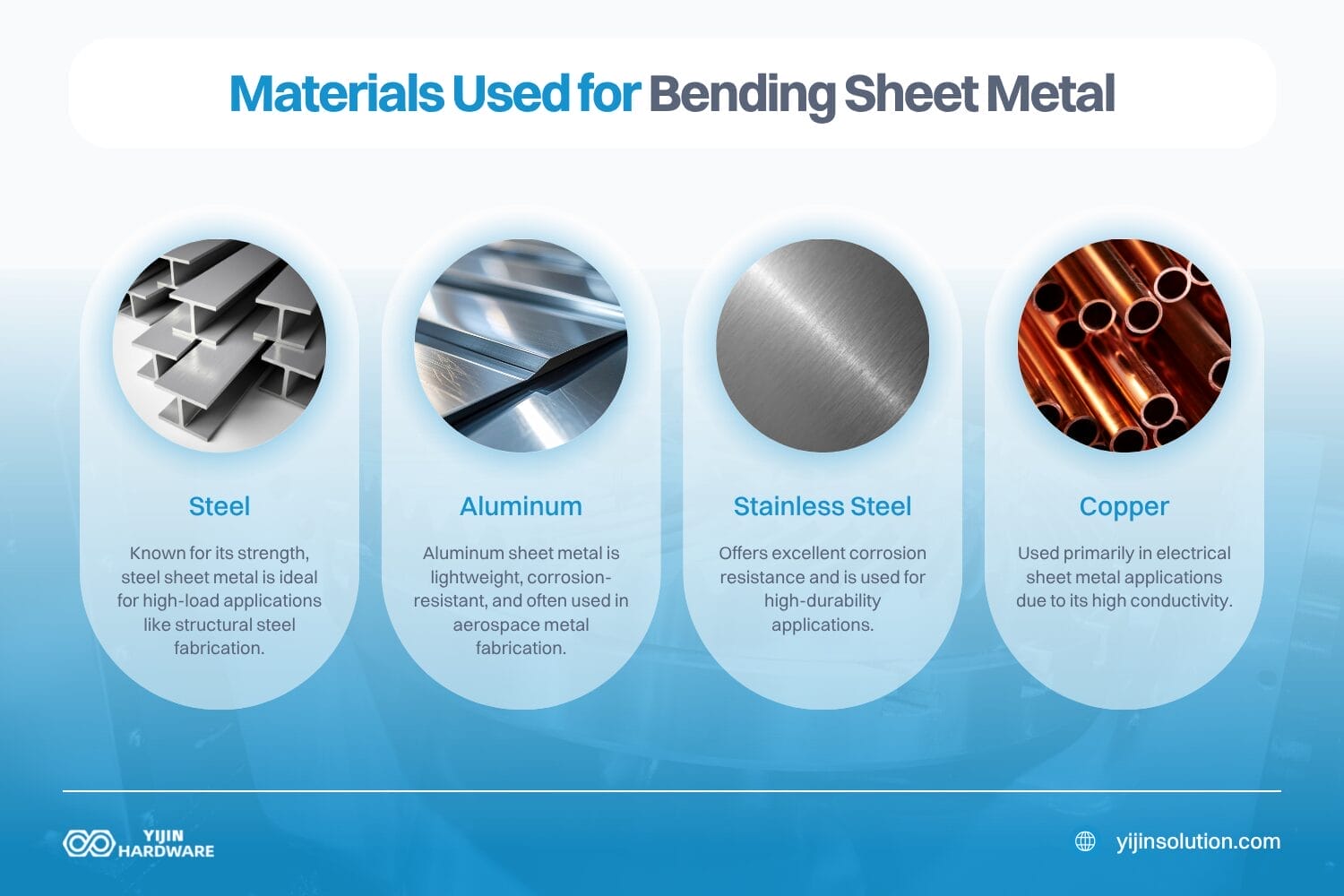
The choice of material plays a critical role in the sheet metal bending process. Some of the most commonly used materials include:
- Steel: Known for its strength, steel sheet metal is ideal for high-load applications like structural steel fabrication.
- Aluminum: Aluminum sheet metal is lightweight, corrosion-resistant, and often used in aerospace metal fabrication.
- Stainless Steel: Offers excellent corrosion resistance and is used for high-durability applications.
- Copper: Used primarily in electrical sheet metal applications due to its high conductivity.
Each type of metal requires different bending techniques and adjustments to ensure the desired results.
What Factors Impact the Sheet Metal Bending Process?
Several factors must be considered to achieve optimal results:
- Material Thickness: The thickness of the sheet affects the force required to bend it and determines the suitable bend radii.
- Bend Radius: A smaller bend radius requires more pressure and can risk cracking if not handled carefully.
- Springback: The material’s tendency to return to its original shape after bending must be accounted for, especially in harder metal sheets like stainless steel.
- Tooling Design: Proper tool selection is crucial for achieving accurate bends and avoiding defects.
By carefully optimizing these factors, Yijin Hardware ensures the production of bent sheet metal parts that meet your exact specifications.
What is Springback in Sheet Metal Bending?
Springback occurs when metal reverts to its original shape after bending. This is especially common in metals like stainless steel. To compensate for this, manufacturers often over-bend the material, knowing that it will “spring back” into the desired angle. CNC systems with adaptive feedback can minimize springback, improving the precision of the bending process.
What is the Role of CNC in Sheet Metal Bending?
CNC (Computer Numerical Control) systems revolutionize the sheet metal bending process by offering high precision and automation. CNC machines control bending angles, bend radii, and bending force with great accuracy, reducing human error.
These systems are ideal for complex sheet metal bending and producing high-quality bent parts in both small and large batches. At Yijin Hardware, we use CNC technology to deliver consistent, repeatable results across all sheet metal bending processes.
The global metal sheet bending machine market is worth about 1 billion US dollars in 2025 according to the latest stats. It is expected to grow slowly and reach around 1.37 billion US dollars by 2035. This means the market gets bigger about 2% each year.
What are the Common Bending Defects?
Common defects in sheet metal bending include:
- Cracking: Caused by excessive pressure or too tight a bend radius.
- Wrinkling: Occurs when the material is compressed unevenly during bending.
- Dimensional Inaccuracy: Happens when bending machines are not properly calibrated.
- Tool Wear: Over time, tools can wear out, leading to inconsistencies in bent sheet metal parts.
By using high-quality bending tools and regularly maintaining our equipment, Yijin Hardware minimizes these defects and ensures accurate results.
Why Choose Yijin Hardware for Sheet Metal Bending?
At Yijin Hardware, we specialize in metal fabrication projects that require complex sheet metal bending. With our state-of-the-art CNC bending machines, we can handle a wide range of bending needs with precision and speed. We focus on quality, cost-efficiency, and customer satisfaction, offering tailored solutions that exceed industry standards. We also offer laser cutting and plasma cutting.
Get Started with Yijin Hardware Today!
What is the formula for bending sheet metal?
The formula for calculating bend allowance (BA) is: BA = (π/180) x (R + K × T) x A, where R is the bend radius, K is the K-factor, T is the material thickness, and A is the bend angle in degrees.
What is the standard for sheet metal bending?
Many sheet metal bending suppliers are certified to ISO 9001 (quality), ISO 14001 (environment), and ISO 45001 (safety), which govern their management systems rather than the bending process itself. Technical bending practices and tolerances are usually defined by engineering standards (e.g. ISO/EN/ASTM material specs) and company or industry design rules.
Back to Top: Bending Sheet Metal Fabrication | Everything You Need to Know




 EN
EN  ES
ES  RU
RU  DE
DE  FR
FR