


CNC milling uses rotating cutting tools to remove material from a stationary workpiece. CNC turning rotates the workpiece against a fixed cutting tool. Your choice depends on your project needs. Milling excels at creating complex shapes and flat surfaces, while turning is best for cylindrical parts.
Interestingly, the automotive industry holds the highest share in the global CNC machine market, according to Fortune Business Insights. This is driven by its significant need for precision and high-volume production of critical components such as engines, transmission parts, and complex body parts.
En Ferretería Yijin, you can order your CNC machining services online. In this article, we’ll explore the differences between CNC milling and CNC turning and which one may be right for your next project.
Principales conclusiones
- The tool interaction between CNC milling and CNC turning is the main difference between the two processes.
- CNC milling is best for manufacturing complex geometrical shapes that require a high level of detail.
- CNC turning is best for manufacturing components with cylindrical shapes.
- CNC turning is also the faster of the two processes, and enables you to manufacture large quantities at record speeds.
What is the Main Difference Between CNC Milling and CNC Turning?
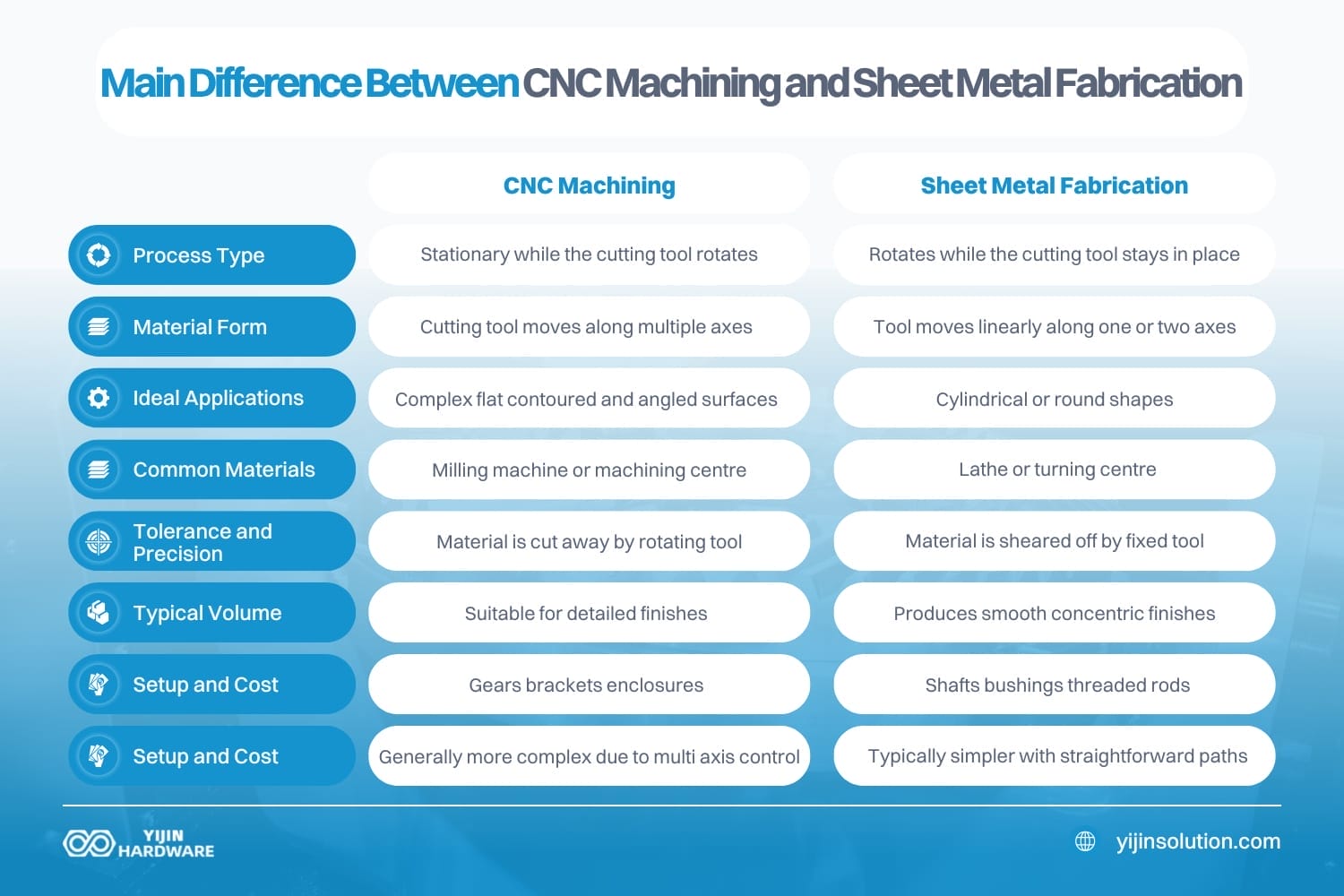
The main difference between CNC milling and CNC turning is how the workpiece and tool interact. In milling, rotating cutting tools remove material from a stationary workpiece. In turning, the workpiece rotates against a fixed cutting tool. Your project’s geometry determines which is best.
Here’s a breakdown of the main differences between CNC turning & milling:
| Característica | Fresado CNC | Torneado CNC |
|---|---|---|
| Workpiece Movement | Stationary while the cutting tool rotates | Rotates while the cutting tool stays in place |
| Tool Movement | Cutting tool moves along multiple axes | Tool moves linearly along one or two axes |
| Ideal Part Shapes | Complex flat contoured and angled surfaces | Cylindrical or round shapes |
| Typical Machine Type | Milling machine or machining center | Lathe or turning center |
| Material Removal Method | Material is cut away by rotating tool | Material is sheared off by fixed tool |
| Acabado superficial | Suitable for detailed finishes | Produces smooth concentric finishes |
| Aplicaciones comunes | Gear bracket enclosures | Shafts bushings threaded rods |
| Complejidad de la programación | Generally more complex due to multi axis control | Typically, simpler with straightforward paths |
Does CNC Turning or CNC Milling Handle Complex Geometries Better?
Yes, CNC milling handles complex geometries better than CNC turning. Your intricate parts with irregular shapes, pockets, and contours are ideal for milling operations. Milling machines can move cutting tools along multiple axes, allowing them to create detailed features on flat and curved surfaces that turning cannot achieve.
CNC Milling and Turning | Do Both Processes Use the Same Cutting Tools?
No, Fresado CNC and turning use different cutting tools designed for their specific operations. Your milling tools have multiple cutting edges and rotate at high speeds, while turning tools have single cutting edges and remain stationary. Each tool type is engineered for the unique way it removes material from the workpiece.
Is CNC Milling or CNC Turning Better for Cylindrical Parts?
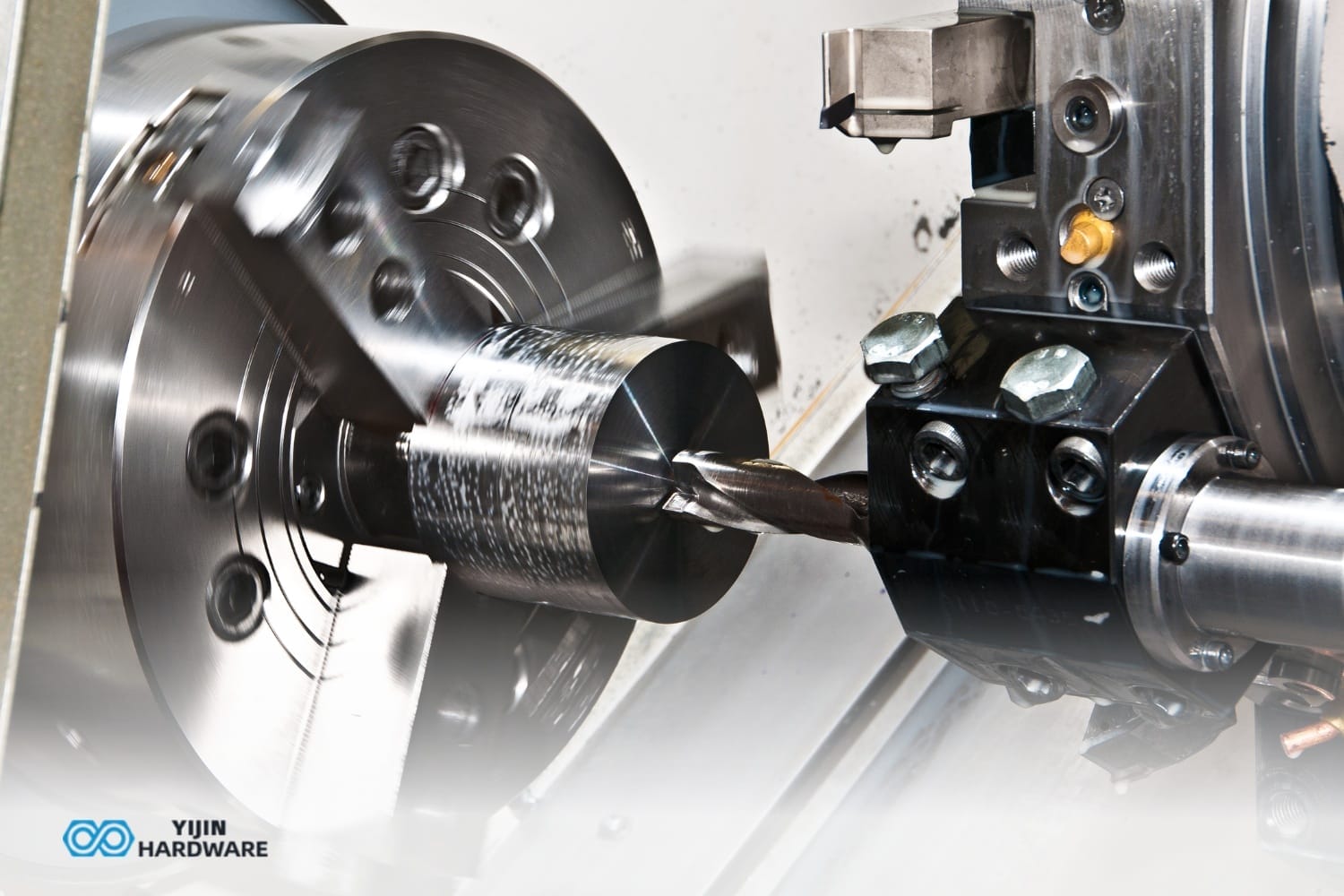
CNC turning is better for cylindrical parts. Your cylindrical components like shafts, pins, and bushings are produced faster and more efficiently with turning. Since the workpiece rotates against a stationary cutting tool, turning naturally creates round, symmetrical shapes with excellent concentricity and surface finish.
Turning operations are actually designed for making cylindrical components. You can achieve tighter tolerances and better roundness when making cylindrical features. The process is also more cost-effective for these parts since the material rotates continuously while the tool removes material in one smooth operation.
Which is Faster Between CNC Turning and Milling?
CNC turning is typically faster than milling for suitable parts. Your cylindrical components can be produced more quickly with turning because the workpiece rotates against a stationary tool. This continuous cutting action removes material efficiently. For round parts, you’ll save significant production time using turning.
When Should You Choose CNC Milling vs. CNC Turning?
Choose CNC milling when your parts have complex geometries with flat surfaces, irregular shapes, or multiple features. Choose Torneado CNC when your parts are cylindrical or have rotational symmetry. Your project requirements like complexity, material, precision, and production volume should drive your decision between these two machining processes.
| Característica | Fresado CNC | Torneado CNC |
|---|---|---|
| Part Geometry | Complex shapes with multiple surfaces | Simple round or tubular shapes |
| Surface Details | Pocket slot holes and contours | Smooth cylindrical surfaces |
| Axis Requirement | Requires multi axis tool movement | Requires rotation around a central axis |
| Complejidad del diseño | Best for intricate and precise features | Best for symmetrical and uniform designs |
| Quantity of Parts | Ideal for low to medium volume production | Ideal for high volume production |
| Customization Needs | Suitable for custom and prototype parts | Suitable for repeated parts with minor variation |
| Fixture Requirements | Requires complex fixturing | Usually needs simple chuck or collet |
| Machining Flexibility | Allows more varied operations in one setup | Limited to turning and some drilling operations |
What Materials are Suitable for CNC Milling and Turning?
Most metals and plastics work well for both CNC milling and turning. Your projects can use aluminum, steel, latón, titanium, copper, and various plastics. Brass is especially popular for both processes because of its excellent machinability. You’ll find it cuts cleanly with minimal tool wear.
Learn more about the CNC milling and CNC turning processes by contacting Yijin Hardware. We’ll help you choose the perfect process for your own manufacturing needs and assist you with implementation too.
CNC Milling vs. CNC Turning FAQs
How many Axes Do CNC Mills and Lathes Typically Have?
CNC mills typically have 3 to 5 axes, while CNC lathes commonly have 2 to 4 axes. Your basic milling machine uses X, Y, and Z axes for movement in three dimensions. Advanced mills add rotational axes (A, B, C) that give you the ability to machine complex shapes from multiple angles.
Are Live Tools used in CNC Turning?
Yes, live tools are used in CNC turning centers. Your modern turning machines can utilize powered rotating tools while the workpiece is stationary. This capability allows you to perform milling, drilling, and tapping operations without moving your part to a separate machine. Live tooling adds versatility to your turning process.
Can CNC Milling Create Threads?
Yes, CNC milling can create threads using specialized tools called thread mills. Your threads can be produced by programming the tool to follow a helical path that cuts the thread profile. This method works for both internal and external threads, giving you flexibility when machining threaded features on complex parts.
Can CNC Turning Create Flat Surfaces?
Yes, CNC turning can create flat surfaces through facing operations. Your workpiece rotates while a cutting tool moves perpendicular to the axis of rotation. This process produces flat surfaces on the ends of cylindrical parts. You can achieve excellent flatness and surface finish with properly executed facing cuts.
Volver arriba: Fresado CNC vs. Torneado CNC | Explicación de las principales diferencias




 ES
ES  EN
EN  RU
RU  DE
DE  FR
FR