


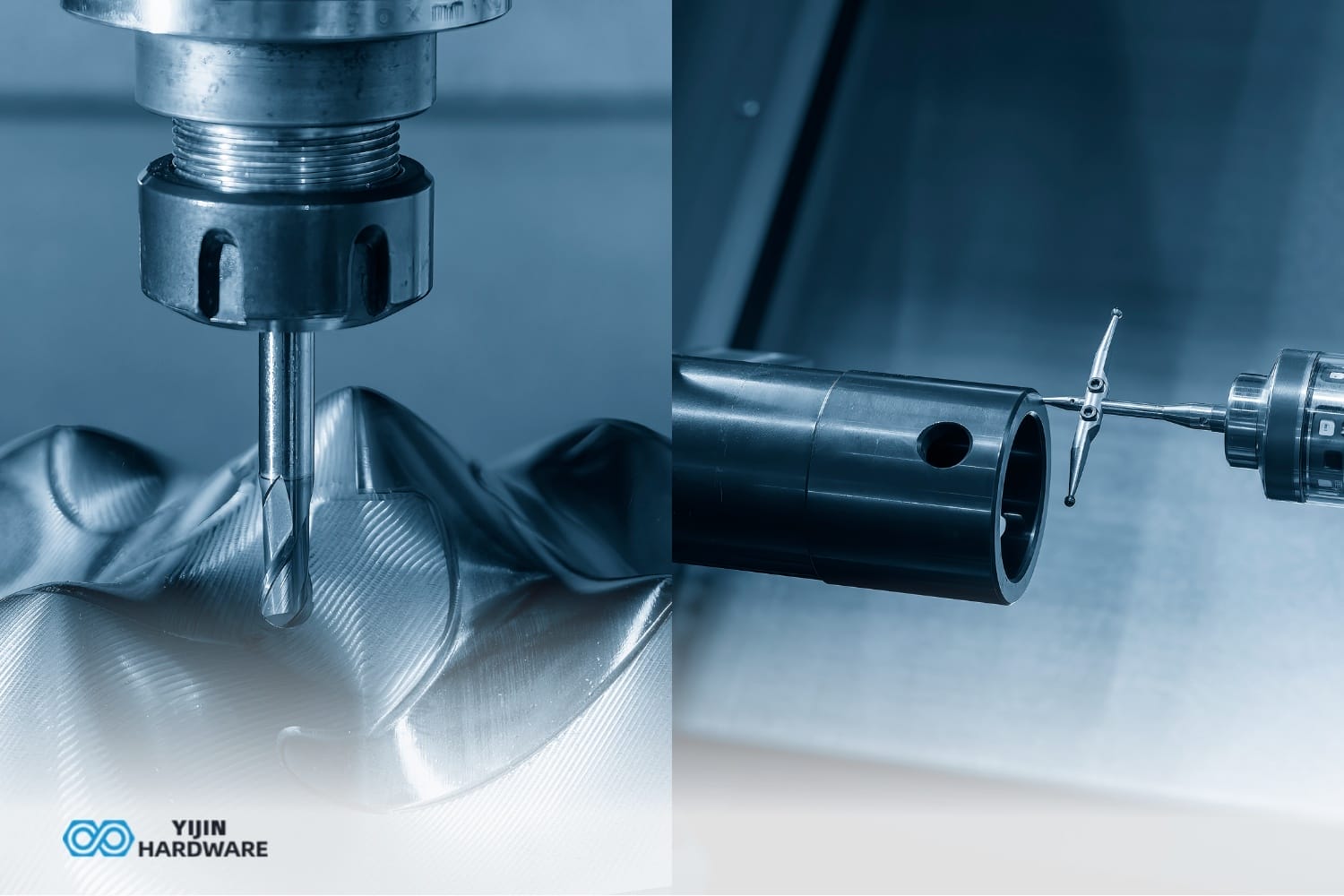
Las fresadoras y las ruteadoras CNC son máquinas de fabricación sustractiva distintas con patrones de movimiento de ejes diferentes. Al examinar las principales diferencias entre las fresadoras CNC y las routers CNC, observamos que las routers tienen piezas de trabajo fijas con husillos que se mueven en los ejes X, Y y Z, mientras que las fresadoras tienen piezas de trabajo que se mueven en los ejes X e Y con husillos que se mueven en Z. Esta diferencia fundamental afecta a sus aplicaciones y capacidades de precisión en el proceso de fabricación por control numérico computerizado (CNC).
Estructuralmente, las fresadoras suelen emplear un diseño de bastidor de pórtico sobre una mesa fija, creando un área de trabajo abierta. Las fresadoras utilizan una estructura de bastidor en C con una columna y una base, concentrando más masa en un espacio más pequeño para lograr una mayor rigidez y amortiguación de las vibraciones. En Ferretería Yijin, Ofrecemos servicios fiables y expertos Fresado CNC China y Servicios de fresado CNC, ofreciendo una rigidez y precisión superiores con nuestra avanzada maquinaria.
Principales conclusiones
- Las fresadoras CNC ofrecen una precisión superior (±0,0001″) y destacan con los metales, mientras que las fresadoras ofrecen áreas de trabajo más grandes para madera y plásticos.
- Las fresadoras utilizan husillos de baja velocidad (3.000-10.000 RPM) y alto par para obtener fuerza de corte, mientras que las fresadoras utilizan alta velocidad (18.000-24.000 RPM) para obtener cortes limpios.
- Las fresadoras cuestan bastante menos ($15.000-$100.000) que las fresadoras ($15.000-$350.000), pero su compatibilidad de materiales es más limitada.
- Las fresadoras disponen de sistemas de herramientas más robustos y pueden utilizar hasta 12 ejes, mientras que las routers suelen tener un máximo de 5 ejes.
- La elección óptima depende de sus materiales, requisitos de precisión, tamaño de la pieza y limitaciones presupuestarias.
Guía de selección de máquinas para sus necesidades de fabricación
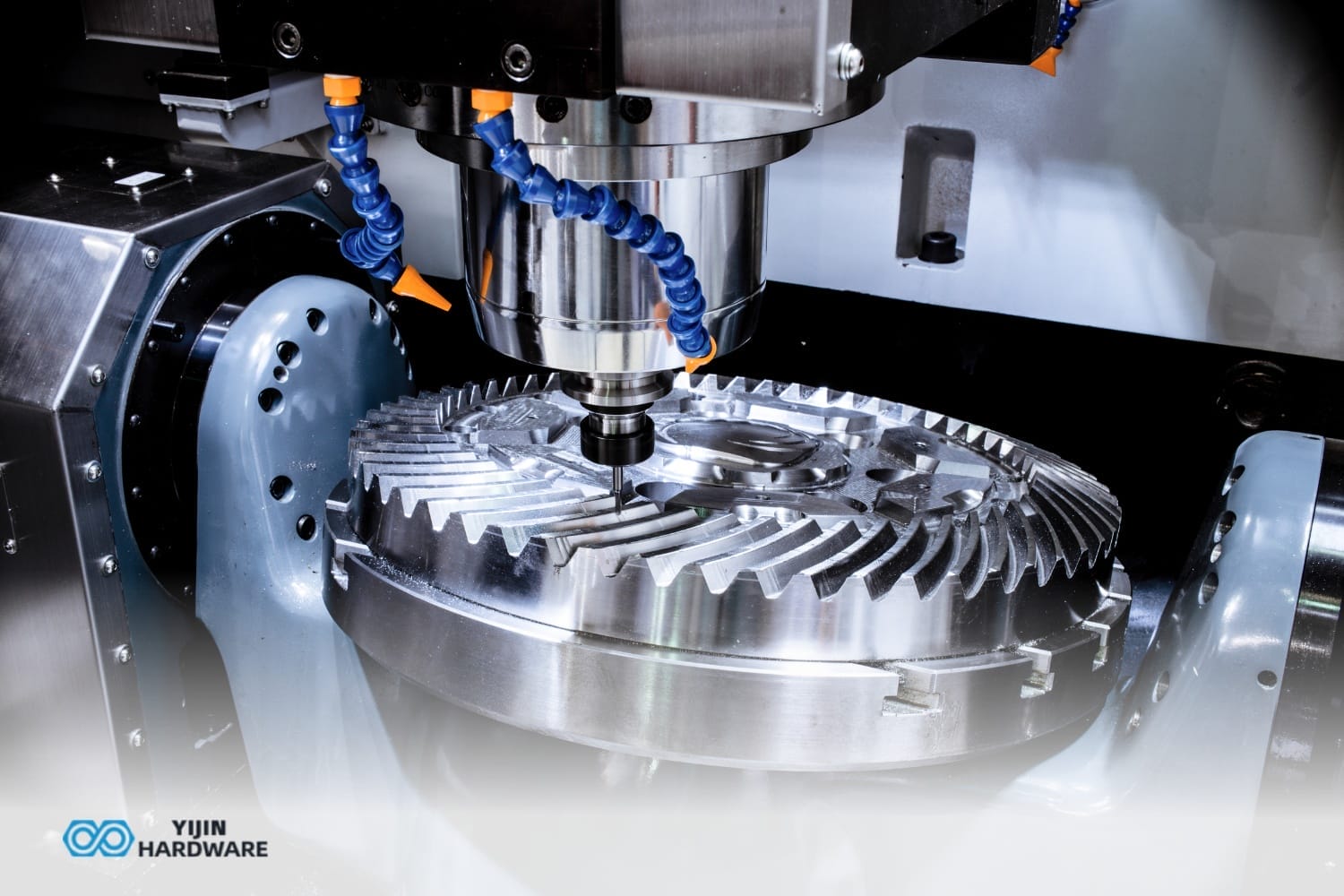
A la hora de elegir entre los servicios de fresado y fresado CNC para su proyecto, tenga en cuenta sus necesidades de máxima precisión, versatilidad y volumen de producción, entre otras. Se trata de un marco de decisión práctico basado en sus requisitos específicos:
| Si tu prioridad es: | Y trabajas principalmente con: | Entonces tu mejor opción es: |
|---|---|---|
| Máxima precisión | Metales, piezas complejas | Servicio de fresado CNC |
| Gran formato | Madera, láminas de plástico | Servicio de fresado CNC |
| Versatilidad de materiales | Materiales mixtos, creación de prototipos | Servicio de mecanizado híbrido |
| Alto volumen de producción | Componentes de madera, armarios | Fresado CNC con automatización |
| Formas 3D complejas en metal | Aeroespacial, piezas médicas | Fresado CNC de 5 ejes |
| Presupuesto limitado, necesidades básicas | Señalización, componentes 2D | Fresado CNC básico |
¿Cómo se comparan las fresadoras y las routers CNC en términos de rigidez y precisión?
Las fresadoras CNC ofrecen una rigidez y precisión superiores, alcanzando tolerancias tan ajustadas como ±0,0001″ (0,0025 mm). Esta precisión excepcional se debe a su estructura en C compacta y rígida que minimiza las vibraciones. Las fresadoras tienen menos flexión durante el mecanizado, manteniendo la consistencia incluso con materiales más duros. Las diferencias entre el mecanizado CNC y el fresado son importantes en este caso: las operaciones de fresado CNC suelen ofrecer una mayor precisión para componentes complejos.
Las fresadoras, con su construcción tipo pórtico, ofrecen una precisión moderada con tolerancias de ±0,005″ (0,13 mm), suficientes para aplicaciones de carpintería y plásticos. Su diseño de puente extendido introduce más posibilidades de flexión y vibración, especialmente a velocidades más altas. Las fresadoras son menos rígidas que las fresadoras, lo que limita su aplicación en materiales más duros.
| Aspecto | Fresadora CNC | Fresadora CNC |
|---|---|---|
| Tolerancia típica | ±0,0001″ (0,0025 mm) | ±0,005″ (0,13 mm) |
| Diseño del marco | Estructura en C (columna y base) | Diseño del pórtico |
| Rigidez | Alta (masa concentrada) | Moderado (puente prolongado) |
| Lo mejor para | Componentes complejos y precisos | Piezas grandes con precisión moderada |
Aplicaciones en las que importa la precisión
Las fresadoras destacan en la creación de componentes precisos con geometrías complejas y tolerancias ajustadas, mientras que las fresadoras son más adecuadas para piezas más grandes en las que la precisión absoluta es menos crítica que la capacidad de tamaño global. La diferencia de precisión resulta especialmente evidente al mecanizar piezas complejas con características intrincadas.
¿Qué materiales puede procesar eficazmente cada tipo de máquina?
Las fresadoras CNC procesan una amplia gama de materiales, incluidos los endurecidos aceros, titanio, acero inoxidable, aluminio, bronce, plásticos y madera. Su robusta construcción y sus husillos de alto par les permiten eliminar material de sustancias resistentes, lo que las hace esenciales en la fabricación aeroespacial y de automoción. El mecanizado CNC abarca múltiples procesos, mientras que el fresado se refiere específicamente al uso de herramientas de corte rotativas.
Las fresadoras CNC destacan con materiales más blandos como la madera, los plásticos, las espumas y, a veces, el aluminio. Están diseñadas para cortar estos materiales a altas velocidades en lugar de por medio de la fuerza, lo que las hace ideales para la fabricación de rótulos y muebles. Las fresadoras tienen dificultades con los metales más duros debido a su rigidez insuficiente. Las fresadoras CNC funcionan excepcionalmente bien para aplicaciones de carpintería en las que es necesario procesar grandes chapas.
| Categoría de material | Fresadora CNC | Fresadora CNC |
|---|---|---|
| Hard Metals (Steel, Titanium) | Excelente | Poor/Not Recommended |
| Soft Metals (Aluminum, Brass) | Excelente | Fair/Limited |
| Plásticos | Bien | Excelente |
| Wood/MDF | Bien | Excelente |
| Large Sheet Materials | Limitado | Excelente |
How do Work Envelope and Table Configuration Differ?
CNC routers provide expansive work areas designed for large sheet materials, with common table sizes of 4’×8′ or 5’×10′. The Tormach 24R CNC Router, for example, features a 2’×4′ envelope to process entire sheets without repositioning. This larger workspace is ideal for furniture components and signage. Most CNC routers and CNC mills differ fundamentally in how the workpiece is held during machining.
CNC mills feature more compact work envelopes, typically under 40″×20″, focusing on precision rather than size. Their smaller work area enables greater mass distribution and rigidity per cubic inch. Mills have a smaller footprint but greater mass, creating a more stable platform for precision machining.
| Aspecto | Fresadora CNC | Fresadora CNC |
|---|---|---|
| Typical Work Envelope | Under 40″×20″ | 4’×8′ or 5’×10′ |
| Design Priority | Concentrated precision | Accommodating sheet goods |
| Workpiece Holding | T-slots, precision vises | Vacuum systems, grid patterns |
| Table Movement | The table moves in X-Y | Table stationary |
What are the Speed and Power Characteristics of Each Machine?
CNC routers operate at higher spindle speeds, but deliver lower torque, relying on rotational speed rather than force. This approach enables rapid removal in softer materials and produces cleaner cuts in wood and plastics. When comparing CNC milling vs. CNC machining, speed characteristics represent one of the key operational differences, along with cutting force and torque.
| Característica | Fresadora CNC | Fresadora CNC |
|---|---|---|
| Typical Spindle Speed | 3,000-10,000 RPM | 18,000-24,000 RPM |
| Torque Output | Alta | Moderate to Low |
| Motor Power | 15-50 HP (industrial) | 3-10 HP (comparable class) |
| Cutting Approach | Force-focused | Speed-focused |
| Performance in Hard Materials | Excelente | Pobre |
How many Axes do Mills and Routers Typically Offer?
CNC mills provide extensive axis capabilities, from basic 3-axis to advanced 12-axis machining centers. Standard 3-axis mills perform most common operations, while 4 and 5-axis mills enable complex contouring, undercuts, and multi-sided machining without repositioning the workpiece. In CNC operations, each axis represents a direction of movement along the X, Y, and Z axes.
CNC routers typically offer 3-axis movement as standard, with some advanced models extending to 4 or 5 axes. The additional axes in routers usually come as rotary attachments or tilting heads for contoured surface cutting. However, multi-axis routing generally lacks the rigidity and precision of comparable mill configurations.
| Configuración de ejes | CNC Mill Capabilities | CNC Router Capabilities |
|---|---|---|
| 3 ejes | Standard configuration for flat surfaces, pockets | Standard for 2D cutting, engraving |
| 4 ejes | Adds rotational capability for cylindrical work | Limited rotary attachments |
| 5 ejes | Complex aerospace parts, medical implants | Decorative carvings, artistic surfaces |
| Max Capability | Up to 12 axes in specialized centers | Generally maxes out at 5-axis |
Which Industries and Applications Best Suit Each Machine Type?
CNC mills excel in sectors requiring precision components from tough materials, including aeroespacial (turbine components), automoción (engine blocks), médico (implants, instruments), and toolmaking (molds, dies). These applications need the mill’s accuracy and material compatibility. The CNC mill can perform complex operations requiring intricate and precise cuts on tougher materials.

CNC routers dominate in woodworking (cabinetry, furniture), signage, architectural millwork, and foam/plastic fabrication. Their large work envelope and high-speed operation suit industries processing sheet goods and softer materials. A typical CNC router is used for softer materials, where speed and work area are prioritized over precision.
Aplicaciones específicas del sector
- For CNC Mills: Aerospace components, automotive parts, medical instruments, tooling, die making, precision mechanical components.
- For CNC Routers: Cabinet making, furniture production, sign manufacturing, foam packaging, architectural elements.
What are the Tooling Differences Between Mills and Routers?
CNC mills utilize robust tooling systems including SK (ISO), CAT, BT, or HSK standardized toolholders with substantial retention force. These precision-ground systems maintain tight tolerances and withstand lateral forces during cutting. Mills typically use end mills with 2–8 flutes, boring heads, and face mills designed specifically for metal removal. The CNC milling machine requires these specialized tools for harder materials.
CNC routers employ simpler tooling setups, often using collet systems with router bits designed for wood and plastic cutting. These tools typically have fewer flutes (1-2) with larger chip clearance spaces optimized for high-volume removal in softer substances. Router bits are designed for high-speed operation rather than force application, working with the high rotational speed to cut softer materials like wood effectively.
| Tooling Aspect | Fresadora CNC | Fresadora CNC |
|---|---|---|
| Standard Toolholding | SK (ISO), CAT, BT, or HSK | Collet systems (ER, TG) |
| Retention Force | Alta | Moderado |
| Common Cutting Tools | End mills, boring heads, face mills | Router bits, V-bits, compression bits |
| Tool Changer Capacity | 20-60+ positions (high-end) | 5–12 positions (if available) |
How do the Costs of Mills and Routers Compare?
CNC mills represent a higher initial investment, with industrial-quality machines typically ranging from $15,000 to $350,000, depending on capabilities. This higher cost reflects their robust construction and advanced features. A Bridgeport-type CNC vertical knee mill starts around $13,000, while advanced 5-axis machining centers can exceed $350,000.
CNC routers offer more accessible entry points, with hobbyist models available from a few hundred dollars and industrial versions typically ranging from $15,000 to $100,000. Desktop CNC routers suitable for prototyping and small-scale production can be acquired for $1,000-$5,000. You can purchase a CNC router for a few hundred dollars at the entry level, while comparable quality mills start much higher.
| Factor de coste | Fresadora CNC | Fresadora CNC |
|---|---|---|
| Nivel de entrada | $13,000+ (Bridgeport-type) | $500+ (hobbyist) |
| Mid-Range | $30,000-$100,000 | $15,000-$50,000 |
| High-End | $100,000-$350,000+ | $50,000-$100,000 |
| Costes operativos | Higher (tooling, energy, maintenance) | Baja |
For businesses seeking CNC machining services, understanding these cost differences helps explain pricing variations between milling and routing services.
What are the Software and Programming Requirements?
CNC mills typically require more advanced CAM (Computer-Aided Manufacturing) software with sophisticated toolpath strategies for efficient metal removal. These programs offer features like adaptive clearing and specialized toolpaths for complex geometries. The differences between CNC machining vs. milling are reflected in their software requirements.
CNC routers generally use more accessible software with graphical interfaces designed for woodworking applications. These programs emphasize ease of use with simplified tool selection. Router programming typically focuses on profile cutting, pocket clearing, and artistic surface treatments. CNC routers are usually programmed with specialized toolpaths for engraving wood and cutting softer materials.
| Software Aspect | CNC Mill CAM | CNC Router CAM |
|---|---|---|
| Complejidad | Higher, with material-specific strategies | Lower, with simplified cutting approaches |
| Toolpath Types | Adaptive clearing, high-speed machining | Profile cutting, pocketing, and engraving |
| Learning Curve | Steeper, requires more technical knowledge | More accessible, often more graphical |
| Coste | Often higher ($2,000-$15,000+) | More affordable ($500-$5,000) |
What are the Practical Advantages of Having Both Machine Types?
Having both a CNC mill and router in your facility creates powerful synergies that overcome the limitations of either machine independently, such as expanded material processing capabilities and workflow optimization. This complementary approach enables complete manufacturing capabilities spanning from large-format panel processing to precision component fabrication. For example, architectural firms can produce both decorative panels on routers and precision metal hardware on mills.
The manufacturing flexibility provided by having both machines allows businesses to accept a wider range of projects and bring more production in-house. A furniture manufacturer with both machines can produce not only wooden components on a router but also create custom metal fittings, jigs, and fixtures on a mill. This versatility reduces dependence on outside vendors and shortens production timelines.
How do you Choose Between a Mill and a Router for Your Specific Needs?
Selecting between a CNC mill and router requires a thorough analysis of your primary applications, materials, precision requirements, and budget constraints. For predominantly metal-focused work requiring tight tolerances, a CNC mill represents the optimal investment, despite its higher cost. Industries like aerospace, automotive, and medical device manufacturing almost exclusively require mills.
For businesses primarily processing wood, plastic, and sheet materials where speed and work area take priority over extreme precision, a CNC router offers the most cost-effective solution. Sign makers, cabinet shops, and panel processors generally find that routers meet their needs more efficiently than mills would.
Factores decisivos
| Factor de decisión | Choose Mill If: | Choose Router If: |
|---|---|---|
| Primary Material | Metals, especially steel, titanium | Wood, plastic, foam, sheet goods |
| Precision Needs | Tolerances under ±0.001″ required | Tolerances of ±0.005″ acceptable |
| Workpiece Size | Smaller, complex parts | Large panels or sheet goods |
| Budget Range | $15,000+ available | Limited budget under $15,000 |
| Volumen de producción | Lower volume, higher precision | Higher volume of similar parts |
| Mecanizado por varias caras | Complex geometries on multiple faces | Primarily 2D or 2.5D work |
| Industry Standards | Aerospace, medical, automotive | Woodworking, signage, and displays |
Environmental and Workspace Considerations
CNC routers use dust extraction systems, as they generate fine particles when cutting wood and plastic. They operate at higher decibel levels (85-95 dB) as the cutting tool moves across the material at high speeds. CNC mills operate in wetter environments with lower-frequency noise (75-85 dB) and produce metal chips that require different containment.
- Debris management: Vacuum systems for routers; chip conveyors for mills
- Noise profile: Higher frequency from routers; lower from mills
- Safety priorities: Respiratory protection for routers; eye protection for mills
- Floor requirements: Mills often need reinforced foundations
Future Trends in CNC Machining Technology
Modern CNC mills operate with increasingly multitasking capabilities, combining various manufacturing processes on a single platform. Meanwhile, routers are developing faster processing speeds and automated material handling. When choosing between a CNC mill or CNC router, consider how these evolving technologies might affect your long-term needs.
Industry 4.0 connectivity is revolutionizing both types of CNC machinery. Features include AI-driven cutting parameters, real-time tool monitoring, and energy optimization. Materials used to cut are expanding as well, with specialized tooling developed for both traditional and composite materials. These advances create smarter machining processes using rotational speed and cutting force more efficiently than ever before.
Según Straits Research, the global CNC milling machines market size is expected to grow to $172.31 billion by 2032!
As a leading provider of precision Servicios de mecanizado CNC, Yijin Hardware offers both advanced CNC milling and routing capabilities to meet diverse client needs. Our specialized team can help determine which machining approach will deliver optimal results for your specific project requirements.
We provide an expert consultation and offer comprehensive capabilities across metals, plastics, and woods. You can rely on our rigorous inspection as powerful quality assurance, along with knowledgeable technical assistance throughout your project.
Póngase en contacto con nosotros para todas sus necesidades de mecanizado CNC
CNC Mill Vs Router FAQs
CNC machining vs. CNC milling: What’s the difference?
Computer numerical control (CNC) machining is a broad manufacturing process that includes milling, turning, and drilling. CNC mills are built to remove material using cutting tools that move along X, Y, and Z axes. CNC routing is typically used for softer materials, while milling is better for metals. The choice between a CNC mill and a CNC router depends on precision and material hardness.
When it comes to CNC machining vs. milling, which is better?
CNC machining includes multiple processes, making it more versatile than just CNC milling. A CNC mill can perform complex cuts at higher rotational speeds, which is ideal for detailed metalwork. In contrast, CNC routers and CNC mills differ in that routers handle wood, plastic, and soft materials efficiently. If you need basic work, you can choose a CNC router instead of an expensive mill.
What are the disadvantages of a CNC milling machine?
CNC mills are expensive, unlike a router, which you can pick up for a few hundred dollars. They also require specialized router bits and tooling, adding to operational costs. Milling machines also have slower cycle times compared to CNC machining services like laser cutting. Despite their precision, they lack the speed and flexibility of a dedicated router.
Volver arriba: Fresadora CNC vs. Router CNC | Comparaciones clave




 ES
ES  EN
EN  RU
RU  DE
DE  FR
FR