



Magnesium is the lightest structural metal used in manufacturing today, with a density 36% lower than aluminum and 75% less than steel, according to Magontec. This silvery-white alkaline earth metal ranks as the eighth most abundant element in the Earth’s crust. Its exceptional strength-to-weight ratio, combined with excellent machinability and recyclability, makes magnesium increasingly valuable across aeroespacial, automoción, electronics, and medical industries.
Our team at Ferretería Yijin regularly works with this light metal during CNC machining and sheet metal fabrication. In this article we’ve outlined what magnesium is, its key properties, and how it’s used in the CNC machining industry.
Principales conclusiones
- Magnesium is the lightest structural metal with an excellent strength-to-weight ratio and outstanding machinability, making it highly valuable for aerospace, automotive, electronics, and medical industries.
- It is produced through the electrolytic and Pidgeon processes—with the latter dominating global production in China due to its lower capital costs and ease of operation.
- In CNC machining, magnesium’s properties allow for higher cutting speeds and superior surface finishes when specialized safety measures, such as proper chip management and cooling methods, are rigorously applied.
What is Magnesium?
Magnesium is a chemical element with the atomic number 12 on the periodic table. Despite being the third most used metal in construction (after iron and aluminum), pure magnesium is never found free in nature due to its high reactivity. Instead, it’s extracted from seawater and natural brines containing approximately 1.3 kg/m³ of dissolved magnesium, as well as minerals such as magnesite (MgCO₃) and dolomite (MgCO₃·CaCO₃).
What are the Key Physical Properties of Magnesium?
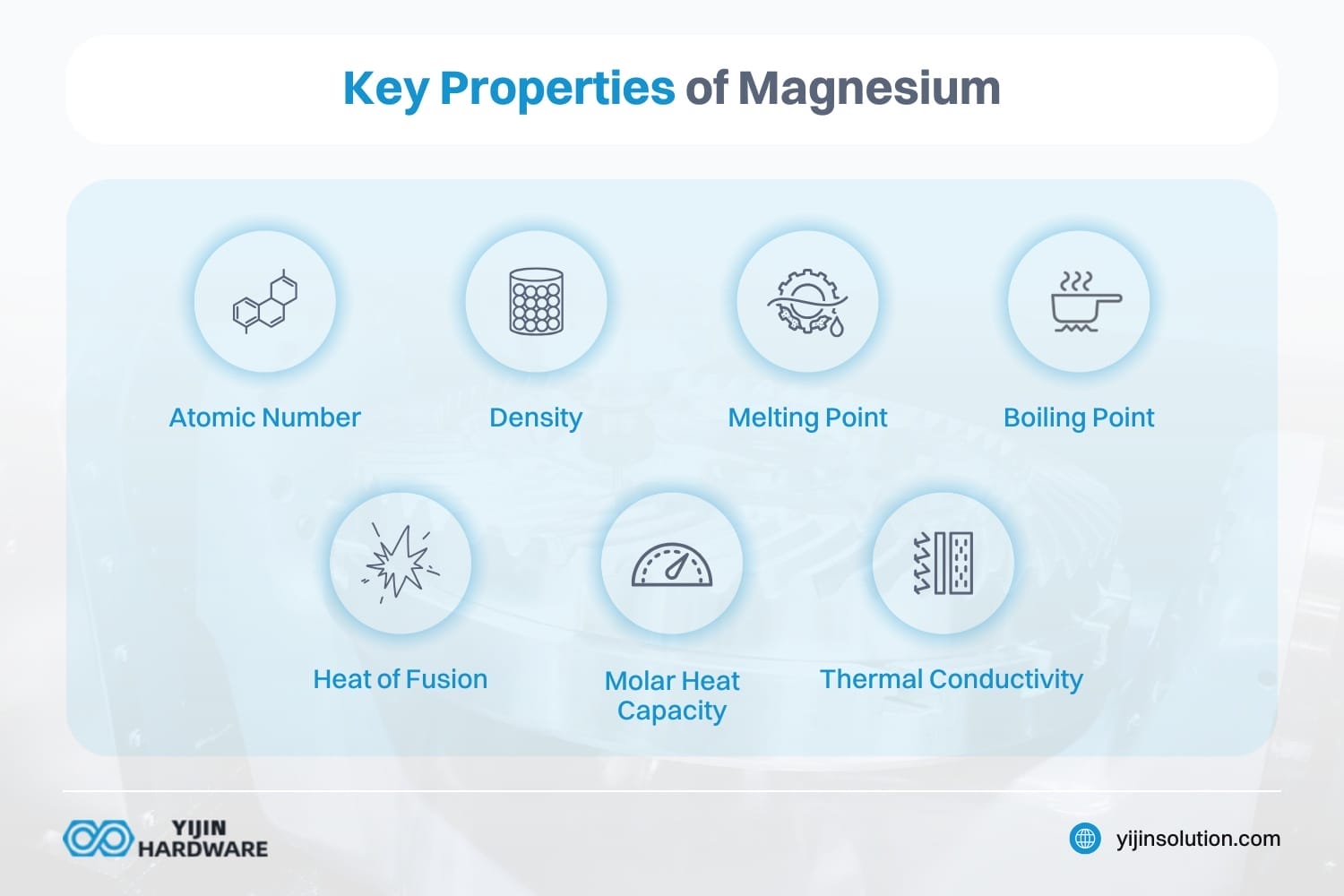
Magnesium possesses unique physical properties that make it valuable for lightweight structural applications. This includes its low density, melting point, and boiling point. We’ve included a table that outlines all the key physical properties of Magnesium below:
| Propiedad | Valor |
|---|---|
| Atomic Number | 12 |
| Density (at 20°C) | 1.737 g/cm³ |
| Punto de fusión | 650°C (923 K) |
| Boiling Point | 1091 °C (1363 K) |
| Heat of Fusion | 8.48 kJ/mol |
| Molar Heat Capacity | 24.869 J/(mol·K) |
| Conductividad térmica | 156 W/m·K |
Magnesium has a hexagonal close-packed (hcp) crystalline arrangement, which influences several key characteristics:
- Pure magnesium lacks sufficient strength for most structural applications, which is why it’s typically alloyed
- When freshly exposed, magnesium exhibits a silvery-white color that gradually develops a gray appearance as a thin protective oxide layer forms
- Its density of 1.737 g/cm³ makes it the lightest structural metal available
How do Magnesium’s Chemical Properties Affect its Performance?
Magnesium’s chemical properties directly influence its performance in manufacturing applications through its reactivity, which creates both advantages and challenges. Magnesium is highly reactive, forming a protective oxide layer when exposed to air. This reactivity creates important performance characteristics for manufacturing applications.
The metal demonstrates excellent electrical conductivity, making it valuable in components that require both lightweight properties and electrical performance. While magnesium is flammable when in powder or thin shaving form, this risk is significantly reduced in solid bulk pieces used in most applications.
Properly engineered magnesium alloys offer good corrosion resistance through careful material selection and surface treatments. The metal’s compatibility with biological systems has led to innovative applications in medical devices, particularly biodegradable implants that can safely dissolve in the body over controlled periods, eliminating the need for removal surgeries.
How is Magnesium Produced Commercially?
Magnesium is formed through two processes commercially: the electrolytic process and the thermal reduction process (often called the Pidgeon Process). We’ve briefly outlined how both processes work to produce commercial magnesium.
What is the Electrolytic Process for Magnesium Production?
The electrolytic process involves two stages:
- Production of pure magnesium chloride: Seawater is treated with calcined dolomite, causing magnesium hydroxide to precipitate. This is converted to magnesium oxide, then to magnesium chloride by heating with carbon in a chlorine stream.
- Electrolysis of fused magnesium chloride: The anhydrous magnesium chloride is melted (655-720 °C) and electrolyzed to produce magnesium metal and chlorine gas according to: MgCl₂ → Mg + Cl₂
This method produces magnesium with approximately 99.9% purity.
How does the Pidgeon Process Work to Produce Magnesium?
The Pidgeon Process, now the dominant production technique worldwide, works as follows:
- Dolomite ore is calcined to produce magnesium and calcium oxides
- This material is mixed with ferrosilicon (80% silicon) and formed into briquettes
- The briquettes are heated to 1200 °C in a vacuum chamber, reducing magnesium oxide to magnesium vapor
- The vapor condenses into crystals, which are then cast into ingots
Despite being energy-intensive, this process dominates global production due to its relatively easy operation and low capital costs. It produces magnesium with up to 99.99% purity.
China has become the world’s dominant producer using this method, accounting for approximately 85% of global production.
What are the Key Benefits and Limitations of Using Magnesium in Manufacturing?
The main benefits of magnesium in manufacturing is its relatively light weight compared to other metals, which makes them easy to machine. This light weight does mean that magnesium has a low melting point and absolute strength compared to other metals in manufacturing. We’ve included a table detailing more benefits and limitations for you to read below.
| Beneficios | Limitations |
|---|---|
| Lightest structural metal (36% lighter than aluminum, 75% lighter than steel) | Flammability concern, especially in powder or thin shaving form |
| Elevada relación resistencia/peso | Susceptibility to corrosion without proper treatment |
| Excellent machinability with higher cutting speeds and better surface finishes | Generally more expensive than aluminum alloys |
| Superior vibration damping capacity (highest among structural metals) | Low melting point (650 °C) limiting high-temperature applications |
| Good thermal conductivity (156 W/m·K) for heat dissipation | Processing complexity compared to other metals |
| Effective electromagnetic interference (EMI) shielding | Lower absolute strength compared to aluminum and steel |
| Fully recyclable with abundant availability | Requires specialized handling during machining for safety |
| Biocompatibility for medical applications | Potential brittleness in certain alloys at low temperatures |
| Can protect other metals from galvanic corrosion when strategically used | Higher energy requirements for production |
When absolute light weight with good strength is required, magnesium excels. For absolute strength, cost-effectiveness, or high-temperature performance, aluminum or steel may be preferable.
What Industries Most Commonly Use Magnesium Components?
Magnesium components are widely utilized across multiple industries, where weight reduction provides significant advantages while maintaining structural integrity. Its beneficial properties make magnesium particularly valuable in transportation, electronics, and medical applications.
Industria aeroespacial
The aerospace sector was among the first to adopt magnesium extensively, using it for aircraft components requiring weight reduction and fuel efficiency improvements. High-performance magnesium alloys containing zirconium and rare earth elements create strengthened components used in critical aerospace applications like helicopter gearboxes and jet engine auxiliary systems, where both weight reduction and vibration damping are essential.
Aplicaciones de automoción
The automotive industry employs magnesium for engine blocks, steering wheels, dashboard structures, and transmission cases to reduce vehicle weight and improve fuel economy. Nearly 70% of the world’s magnesium production goes into making alloys, with about half of those alloys used in die casting automotive components that typically contain about 90% magnesium. Performance vehicles particularly benefit from magnesium’s properties in seat frames and structural elements.
Electronics and Consumer Products
The electronics industry values magnesium for laptop and tablet casings, mobile phone frames, and camera bodies, particularly in high-end equipment. Magnesium’s excellent EMI shielding properties make it ideal for sensitive electronic devices, while its superior heat dissipation capabilities help manage thermal issues in compact designs. Power tool manufacturers leverage magnesium’s light weight and vibration damping properties to create more comfortable and efficient tools.
Industria médica
The medical sector utilizes magnesium for biodegradable implants and surgical instruments, where its biocompatibility offers unique advantages. Magnesium’s ability to be safely absorbed by the body over time enables the creation of temporary implants that don’t require removal surgery, reducing patient trauma and healthcare costs while supporting the healing process.
Otras aplicaciones
Beyond these major industries, magnesium serves as sacrificial anodes to protect steel ships’ hulls and underwater structures from corrosion. Approximately 10% of global magnesium production is used for desulfurization in steel manufacturing. The metal also plays a key role as an alloying element in aluminum products like beverage cans, and its high reactivity makes it valuable in pyrotechnics, fireworks, and emergency flares where its bright white light is highly visible.
How is Magnesium Used in CNC Machining?
CNC machining magnesium requires specialized knowledge to leverage its advantages while managing its unique characteristics. The exceptional machinability of magnesium allows for efficient manufacturing processes when proper protocols are followed.
Consideraciones sobre el mecanizado
When machining magnesium, higher cutting speeds are possible compared to other metals, which can increase productivity and reduce overall machining time. This exceptional machinability contributes to reduced power consumption and extended tool life. Proper chip management systems are essential due to the flammability risk associated with fine magnesium chips and dust, requiring dedicated collection and disposal protocols.
Cooling methods must be carefully selected when machining magnesium, as water-based coolants should generally be avoided due to potential hydrogen gas generation, while oil-based coolants must be monitored to prevent fire hazards. Tool selection impacts results significantly, with carbide tools featuring specific geometries typically providing optimal surface finish and efficiency.
Safety Protocols
Safety is paramount when machining magnesium and requires several important measures. Specialized fire suppression systems that don’t use water (which can react with burning magnesium) must be installed in machining areas. Proper ventilation systems are necessary to continuously remove any magnesium dust from the work environment.
Regular cleaning schedules prevent the dangerous accumulation of chips and dust on equipment and surrounding areas. Comprehensive operator training covering the specific risks and handling protocols for magnesium is essential before allowing work with this material. Magnesium machining operations should be physically separated from any processes involving sparks or open flames to minimize ignition risks.
Finishing Treatments
After machining, magnesium components typically receive surface treatments to enhance their performance and longevity. Anodizing processes create protective oxide layers that improve corrosion resistance and surface hardness. Chemical conversion coatings provide additional protection against environmental factors.
Painting or powder coating options offer both protective and aesthetic benefits for finished components. Specialized sealants can be applied to prevent moisture intrusion in critical applications. These treatments collectively protect against corrosion while enhancing both the functional properties and visual appearance of the machined magnesium parts.
FAQs on What is Magnesium?
How is magnesium manufactured?
Magnesium is manufactured primarily through two methods: the electrolytic process that extracts magnesium from magnesium chloride through electrolysis, and the Pidgeon Process, a thermal reduction method where dolomite ore is heated with ferrosilicon in a vacuum to produce magnesium vapor. Both methods require substantial energy input, with the Pidgeon Process being more common despite its lower efficiency.
Which country is the largest producer of magnesium?
China is the largest producer of magnesium in the world, accounting for approximately 85% of global production. The country’s dominance in magnesium production has grown dramatically since the 1990s, largely due to its implementation of the Pidgeon Process in regions with low energy and labor costs.
Can you CNC magnesium?
Yes, magnesium can be CNC machined with excellent results when proper safety protocols are followed. Magnesium offers superior machinability with higher cutting speeds and better surface finishes than many other metals, but requires specialized chip management systems and fire safety measures due to its flammability when in powder or thin shaving form.
Volver arriba: What is Magnesium? | Properties, Production & Applications in CNC Machining






 ES
ES  EN
EN  RU
RU  DE
DE  FR
FR