



Material selection fundamentally determines manufacturing success in precision engineering projects. Brass and copper represent two of the most versatile and widely utilized metals in CNC machining operations, each offering distinctive advantages for specific applications. The decision between these metals significantly impacts project outcomes, from performance characteristics to production costs.
We’re Quincaillerie Yijin, and we’ll be exploring the essential distinctions between copper and brass. We’ll help you understand their composition, physical properties, machining characteristics, and ideal applications. By the end, you’ll gain the expertise needed to make informed material selections for your next CNC machining project.
Principaux enseignements
- Brass is an alloy of copper and zinc that offers enhanced hardness, improved machinability, and a distinctive gold-like appearance compared to pure copper’s reddish-brown hue.
- In CNC machining, brass enables higher cutting speeds, superior surface finishes, and longer tool life, while copper excels in electrical and thermal conductivity.
- Overall, brass tends to reduce production costs through greater machining efficiency and fewer secondary operations, making it a preferred choice for high-volume precision projects.
What is the Difference Between Brass and Copper?
The different metal composition forms the primary distinction between brass and copper. Copper exists as a pure elemental metal, represented on the periodic table as Cu with atomic number 29. Brass, on the other hand, functions as an alloy created by combining copper with varying amounts of zinc, typically containing between 67-85% copper and 15-33% zinc, though these proportions can vary significantly depending on the specific brass alloy.
This fundamental difference in composition explains their distinct characteristics and behaviors. Copper occurs naturally in metallic form, while brass is entirely human-made through alloying processes. The addition of zinc to copper creates a material with enhanced hardness, machinability, and corrosion resistance compared to pure copper.
If you want to discern the difference between the two at a glance, copper displays a characteristic reddish-brown color, while brass exhibits a yellowish-gold appearance that varies in shade depending on its zinc content. This color difference provides an immediate visual cue for distinguishing between these metals in manufacturing settings.
How do Brass and Copper Compare in Physical Properties?
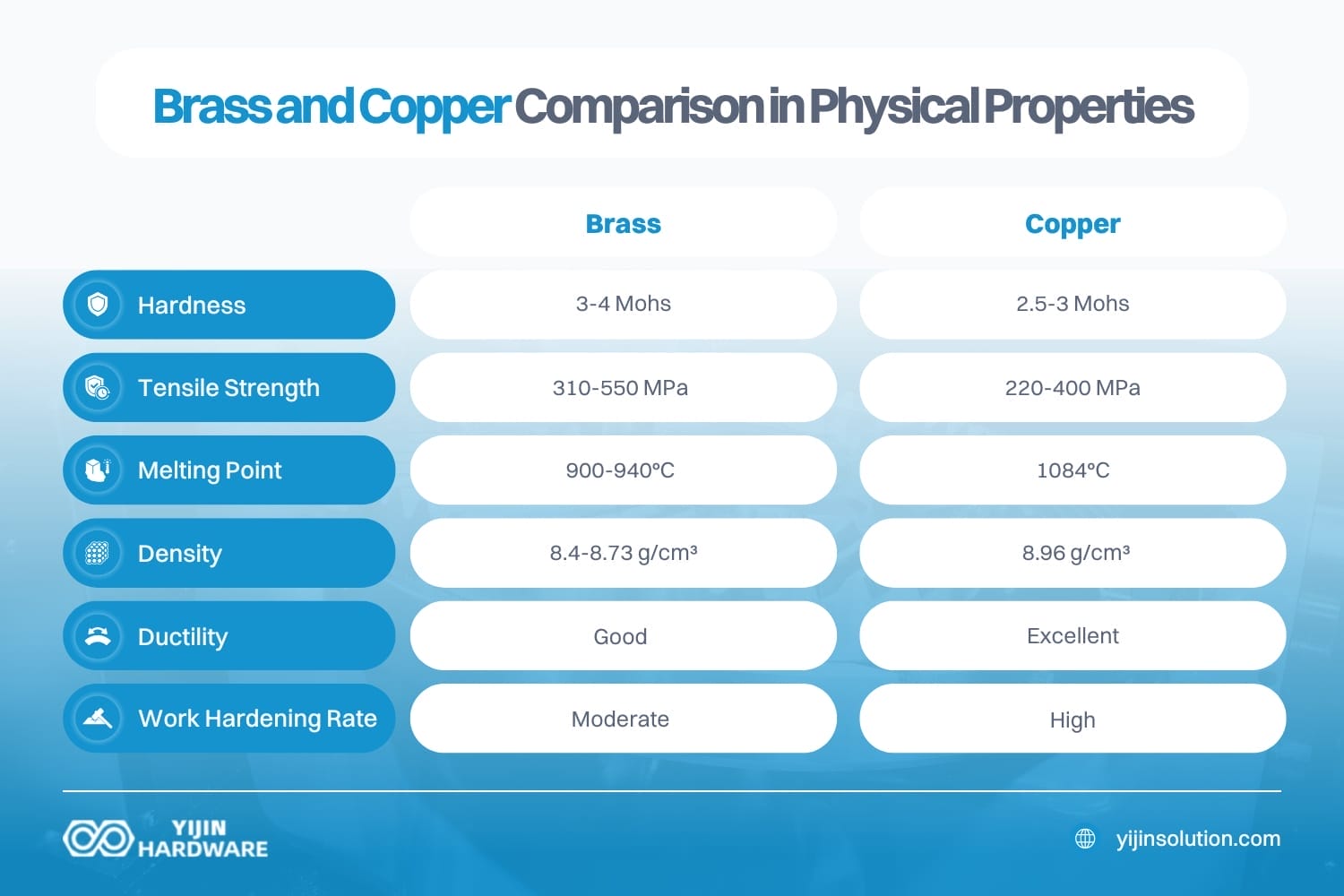
Material hardness varies significantly between these metals due to their compositional differences. Brass typically measures between 3-4 on the Mohs hardness scale, while pure copper registers around 2.5-3, making brass approximately 25-30% harder. This increased hardness gives brass superior wear resistance and durability in mechanical applications.
Several critical physical property differences influence material selection for CNC machining:
| Propriété | Laiton | Cuivre | Application Impact |
|---|---|---|---|
| Hardness (Mohs Scale) | 3-4 | 2.5-3 | Brass offers 25-30% higher hardness for better wear resistance |
| Résistance à la traction | 310-550 MPa | 220-400 MPa | Brass provides greater strength for load-bearing components |
| Point de fusion | 900-940 °C | 1084 °C | Copper requires higher temperatures for casting and joining |
| Densité | 8.4-8.73 g/cm³ | 8.96 g/cm³ | Copper is slightly heavier for equivalent volumes |
| Ductilité | Bon | Excellent | Copper can be drawn into finer wires and formed into more complex shapes |
| Work Hardening Rate | Modéré | Haut | Copper requires more frequent annealing during forming operations |
How do Brass and Copper Differ in Appearance?
Metal coloration provides the most obvious visual distinction between brass and copper. Copper displays a distinctive reddish-brown hue that, when freshly polished, exhibits a warm, salmon-pink appearance highly valued in decorative applications. When exposed to atmospheric conditions, copper develops a characteristic patina that progresses from brown to eventually form a green verdigris coating (copper carbonate) over many years.
In contrast, brass presents a gold-like appearance that ranges from rich yellow to pale gold depending on its zinc content. Brass alloys with higher zinc percentages (above 35%) exhibit lighter, more silvery tones, while those with lower zinc content (around 15%) display warmer, more copper-like coloration. Unlike copper, brass maintains its golden appearance longer before developing a darker, browner patina.
How do These Metals Perform in Corrosive Environments?
Corrosion resistance varies between brass and copper depending on the specific environment. Copper exhibits excellent resistance to atmospheric corrosion by forming a protective patina layer of copper oxide and eventually copper carbonate that shields the underlying metal from further deterioration. However, copper remains vulnerable to certain acids, strong alkalis, and environments containing hydrogen sulfide.
Brass demonstrates enhanced corrosion resistance in many environments due to its zinc content, which forms protective surface compounds. Standard brass alloys (containing 30-35% zinc) offer excellent resistance to:
- Freshwater Environments: Brass outperforms copper in most freshwater applications, showing minimal corrosion even after extended exposure.
- Atmospheric Conditions: Both metals perform well in normal atmospheric conditions, though brass maintains its appearance longer before developing patina.
- Weak Acids and Alkalis: Brass generally demonstrates better resistance to mild chemical exposures than pure copper.
However, brass faces a significant vulnerability in saltwater or chloride-rich environments where it can experience dezincification—a selective leaching process where zinc is removed from the alloy, leaving a porous, weak copper structure. This vulnerability makes standard brass unsuitable for marine applications unless specially formulated with tin (naval brass) or other elements to prevent this corrosion mechanism.
For components exposed to harsh or unpredictable environments, specialized alloys like admiralty brass (containing tin) or aluminum brass offer enhanced corrosion resistance, while maintaining many of the desirable characteristics of standard brass alloys.
What are the Cost Considerations Between Brass and Copper?
Material pricing reveals significant differences between these metals, with pure copper typically commanding a 15-30% price premium over common brass alloys in raw material form. As of April 2025, industrial-grade copper averages approximately $4.57 per pound, while common brass alloys range from $3.20-3.90 per pound depending on grade and zinc content.
However, total project costs extend beyond raw material prices, encompassing several manufacturing considerations:
- Machining Efficiency: Brass’s superior machinability reduces processing time by 60-75% compared to copper for many operations, significantly lowering labor and machine time costs.
- Tool Replacement: Cutting tools last 3–5 times longer when machining brass compared to copper, reducing tooling costs for production runs.
- Secondary Operations: Copper often requires additional finishing steps to achieve comparable surface quality to brass, increasing overall production costs.
- Scrap Value: Both metals maintain excellent recyclability and scrap value, though copper scrap typically commands higher prices than brass.
- Production Volume Considerations: For high-volume production, brass’s manufacturing efficiency advantages often outweigh its slightly lower material cost compared to copper.
For most CNC machining applications, the total cost analysis typically favors brass despite its higher raw material price, particularly for complex components with significant machining requirements. However, for applications where copper’s unique properties are essential, the higher production costs may be unavoidable and justified by performance requirements.
How do These Metals Compare in Electrical and Thermal Conductivity?
Conductivity performance represents one of the most significant functional differences between these metals. Copper stands as the industry standard for electrical conductivity at 100% IACS (International Annealed Copper Standard), while common brass alloys typically measure between 23-44% IACS depending on their zinc content. This substantial difference makes copper the preferred choice for electrical applications, despite its higher cost.
The comparative conductivity values demonstrate important differences:
| Propriété | Pure Copper | Yellow Brass (70Cu/30Zn) | Red Brass (85Cu/15Zn) |
|---|---|---|---|
| Electrical Conductivity (% IACS) | 100% | 28% | 44% |
| Conductivité thermique (W/m-K) | 398 | 120 | 159 |
| Resistivity (nΩ·m) | 16.78 | 59.2 | 38.4 |
While brass can serve in some electrical applications where space constraints are minimal and efficiency is less critical, copper remains the definitive choice for applications where conductivity performance is a primary consideration.
Which Metal Offers Better Machinability for CNC Projects?
CNC machinability represents a critical consideration for manufacturing efficiency. Brass significantly outperforms copper in machining operations, with common brass alloys achieving machinability ratings of 80-100 on the standardized scale, where free-cutting steel equals 100. By comparison, pure copper typically rates between 20-40, making brass approximately 2.5-4 times more machinable.
| Machining Factor | Laiton | Cuivre | Manufacturing Impact |
|---|---|---|---|
| Machinability Rating | 80-100 | 20-40 | Brass is 2.5-4 times more machinable overall |
| Vitesse de coupe | 600-700 sfm | 200-300 sfm | Brass allows 2-3 times faster cutting speeds |
| Durée de vie de l'outil | Excellent | Médiocre-équitable | Tools last 3–5 times longer when machining brass |
| Finition de la surface | Excellent | Juste | Brass requires fewer secondary finishing operations |
| Précision dimensionnelle | Haut | Modéré | Brass experiences less deformation during machining |
| Formation des copeaux | Short, breaks cleanly | Long, stringy | Brass chips are more manageable and reduce tooling damage |
Leaded brass alloys like C360 (containing approximately 3% lead) offer particularly exceptional machinability, making them the preferred choice for complex CNC machining operations requiring tight tolerances and excellent surface finish. However, environmental regulations increasingly restrict leaded materials in many applications, making lead-free alternatives like bismuth-containing brass alloys increasingly important.
Au Quincaillerie Yijin, we offer CNC machining and sheet metal fabrication options for both brass and copper, helping manufacturers meet sustainability goals while maintaining performance requirements. Contact us today if you plan to use brass or copper for your CNC machining.
Brass vs. Copper FAQs
Is brass or copper better for machining?
Brass is generally better for machining than copper due to its higher machinability rating and uniform grain structure, which reduces tool wear and ensures smoother finishes. Brass can be machined at higher speeds with minimal tool wear, making it ideal for high-volume production for multiple industries, including plumbing and musical instruments.
What is the machinability rating of brass?
Free-cutting brass, such as C360, has a machinability rating of 100%, making it the benchmark among metals for machining. Other brass alloys typically range from 90% to 100%, depending on their composition and lead content.
Why is brass so easy to machine?
Brass is easy to machine due to its unique composition, which often includes lead that acts as a lubricant during cutting. This reduces friction, minimizes tool wear, and allows high-speed machining. Brass’s ductility and thermal conductivity further enhance its machinability, enabling precise cuts and smooth finishes even during extended machining periods.
Retour en haut de la page : Brass vs. Copper | CNC Machining Manufacturing






 FR
FR  EN
EN  ES
ES  RU
RU  DE
DE