



7-axis Usinage CNC is an advanced manufacturing technology that utilizes seven distinct axes of movement (X, Y, Z, A, B, C, and E) to achieve unparalleled precision, flexibility, and efficiency in the production of complex components. This technology allows for the production with tolerances as fine as 0.00004 inches (1 micron) in a single setup.
It is widely used in industries such as aerospace and automotive, where precision is crucial, and continues to grow at 6.3% annually due to increasing demand in aerospace, medical, and automotive industries according to Data Intelo.
Unlike conventional 3-axis or 5-axis systems, 7-axis CNC machines approach workpieces from virtually any angle, creating geometries that would be impossible or highly inefficient to produce using simpler machining systems. Our team at Yijin Hardware has detailed everything you need to know about 7-axis CNC machining right here.
Principaux enseignements
- 7-axis CNC machining harnesses three linear and four rotational axes to achieve precision and efficiency in producing components with tight tolerances in a single setup.
- This advanced technology is particularly beneficial for industries like aerospace, automotive, and medical manufacturing, where intricate geometries and micron-level accuracy are essential.
- While 7-axis systems offer significant production advantages by reducing setup times and secondary operations, they also require specialized programming expertise and higher initial investments.
What are the 7 Axes in 7-axis CNC Machining?
The seven axes in 7-axis CNC machining comprise three linear movement axes and four rotational axes, each serving a specific function in the creation of sophisticated parts:
Linear Axes in 7-Axis Machining
The three linear axes form the foundation of all CNC machining operations:
- X-Axis: Controls horizontal movement (left to right), allowing precise lateral positioning with movement ranges typically between 500 mm-2000 mm depending on machine size. This axis enables the tool or workpiece to move horizontally across the machine bed.
- Y-Axis: Manages vertical movement (up and down), enabling vertical positioning with typical travels of 400 mm-1500 mm and positioning accuracy of ±0.003 mm. This axis allows the tool or workpiece to move vertically.
- Z-Axis: Provides forward and backward movement, controlling the tool’s approach to the workpiece with travel distances of 400 mm-1200 mm and repeatability of ±0.0015 mm. This axis determines the depth of cuts and overall part dimensions.
Rotational Axes in 7-Axis Machining:
The four rotational axes dramatically enhance machining capabilities beyond traditional 3-axis systems:
- A-Axis: Enables rotation around the X-axis, significantly enhancing angular capabilities, with typical rotational ranges of ±120 degrees and accuracy of ±0.001 degrees. This rotation allows access to features that would otherwise require multiple setups.
- B-Axis: Permits rotation around the Y-axis for approaching workpieces from different angles, typically offering ±110 degrees of rotation with positioning accuracy of ±0.001 degrees. This axis is critical for machining contours and angled surfaces.
- C-Axis: Allows rotation around the Z-axis, completing the rotational capability set with 360-degree continuous rotation and positioning accuracy of ±0.001 degrees. This axis enables spiraling cuts and circular features.
- E-Axis: Often referred to as the “twisting arm,” this additional axis provides enhanced flexibility for operations through rotational movements that complement the other axes. This axis is what distinguishes 7-axis systems from 5-axis machining, enabling extraordinary flexibility in tool positioning.
These seven axes work in perfect coordination, allowing the machine to approach a workpiece from virtually any angle and execute complicated toolpaths that would be impossible with fewer axes. The result is the ability to create intricate geometries with exceptional precision and minimal extended setup time.
What are Different Types of 7-Axis CNC Machines?
7-axis CNC machines come in various forms, including machining centers and robot arms. Machining centers are traditional CNC machines with 7-axis capabilities, capable of both milling and turning operations. Here’s the table comparing the types of 7-axis CNC machines:
| Type de machine | Precision Capability | Typical Workpiece Size | Material Suitability | Investissement initial | Meilleures applications |
|---|---|---|---|---|---|
| Machining Centers | ±0.00004” (1 micron) | Small to medium (up to 2 cubic feet) | All materials, including hardened steel | $500,000-$1,200,000 | Composants aérospatiaux, implants médicaux |
| Robot Arms | ±0.002” (0.05 mm) | Medium to large (up to 8 cubic feet) | Softer materials (wood, plastic, aluminum) | $350,000-$700,000 | Automotive prototyping, artistic components |
| Swiss Machines | ±0.00004” (1 micron) | Very small (less than 1.5” diameter) | All materials, including exotic alloys | $400,000-$900,000 | Precision medical devices, watch components |
| Gantry Systems | Varies by end effector | Multiple machine service | Handles various parts for loading/unloading | $600,000-$1,300,000 | High-volume production automation |
À la recherche de Fraisage CNC Chine manufacturing services? At Quincaillerie Yijin, we specialize in high-precision CNC milling solutions et Services de tournage CNC from Chine, offering a range of advanced 7-axis CNC machines to ensure superior results for your projects.
What are the Applications and Industries 7-axis CNC Machining is used in?
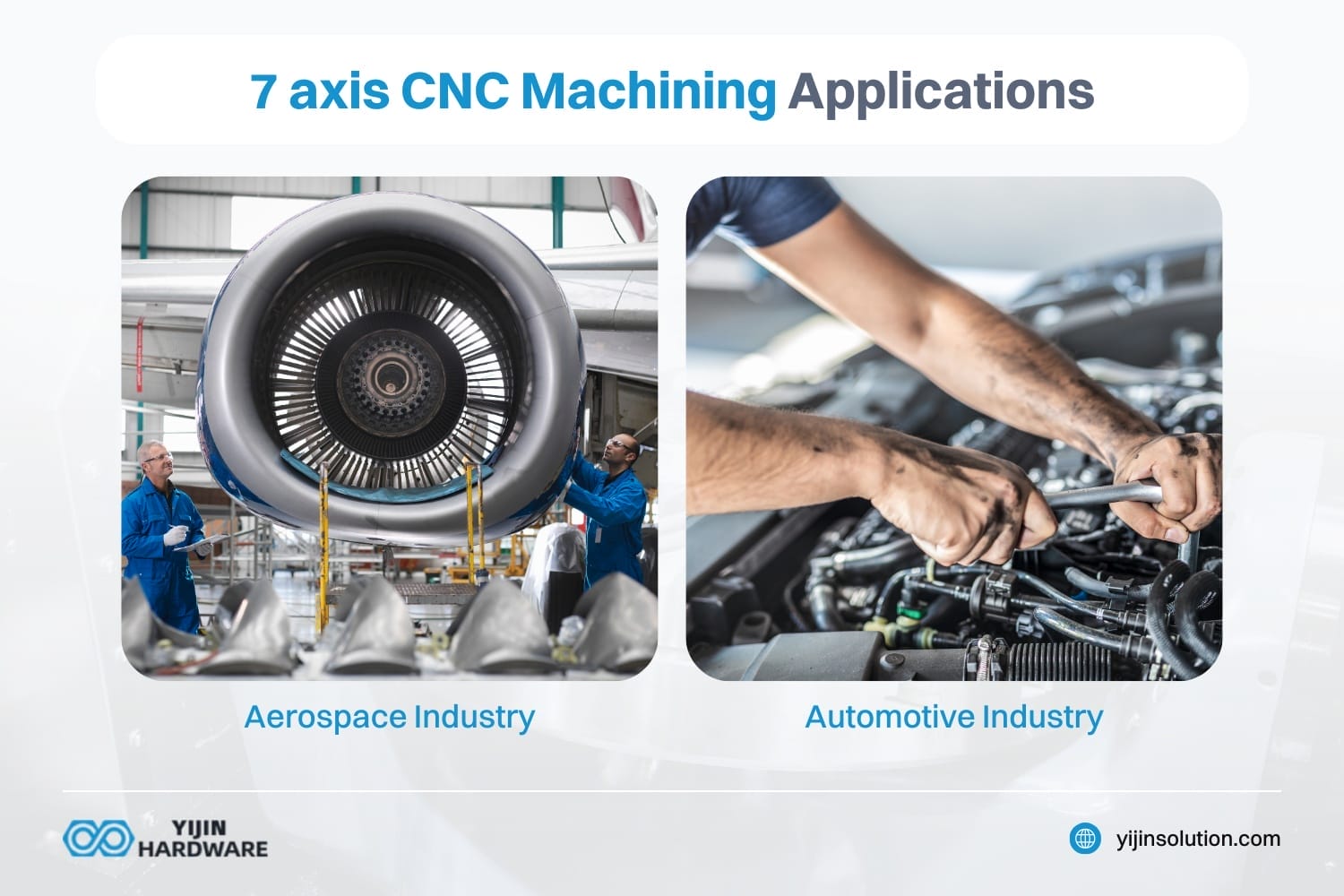
7-axis CNC machining is ideal for manufacturing complex parts with intricate details. It is widely used in the aérospatiale et automobile industries, where high precision and tight tolerances are essential. In these industries, the ability to produce parts as efficiently significantly reduces production time and improves quality.
Industrie aérospatiale
The aerospace sector was among the earliest adopters of 7-axis CNC machining due to its need for extraordinary precision in critical components. Aerospace manufacturers utilize this technology to produce difficult-to-make turbine blades, impellers, and structural elements with aerodynamic surfaces requiring micron-level precision of ±0.0005” (0.0127 mm).
These applications process demanding materials like Inconel and titane while maintaining structural integrity, with 7-axis systems particularly valued for their ability to machine elaborate geometries in a single setup that would otherwise require multiple operations.
Fabrication de dispositifs médicaux
The medical industry relies on 7-axis machining to create life-critical components with organic geometries and exceptional surface finishes. Orthopedic implants, surgical instruments, and dental components require precision within 0.0001″ (2.54 microns) and perfect biocompatibility using materials like titanium and cobalt-chrome alloys.
The unique ability of 7-axis machines to create anatomically correct shapes with perfect surface finish (as low as 0.4 μm Ra) eliminates secondary operations while ensuring components that interface directly with human tissue meet stringent regulatory requirements.
Industrie automobile
Automotive manufacturers leverage 7-axis machining for both production components and prototyping applications requiring intricate geometries. Engine components, transmission parts, and performance racing elements benefit from the ability to maintain tolerances within ±0.001” (0.0254 mm) across high-volume production runs of aluminum and steel components.
The automotive sector particularly values 7-axis technology for its ability to combine high-precision with production efficiency, reducing setup times by up to 80% for complicated components while maintaining consistent quality across thousands of identical parts.
Applications militaires et de défense
Defense applications represent some of the most demanding use cases for 7-axis machining, requiring extraordinary precision for mission-critical components. Guidance systems, specialized armaments, and communication equipment with complex electromagnetic shielding must maintain tolerances within 0.0003” (7.62 microns) under all operating conditions while processing challenging materials like hardened steels and specialized alloys.
Military applications demonstrate how 7-axis machining delivers both the precision and reliability required for equipment where component failure is not an option, with the additional benefit of domestic manufacturing capability for sensitive technologies.
How to Choose Between 5-Axis and 7-Axis CNC Machining?
Selecting the optimal machining technology requires careful evaluation of specific manufacturing requirements. This decision framework helps manufacturers select the appropriate technology based on their specific requirements, rather than simply choosing the most advanced option.
| Choose 5-Axis When | Choose 7-Axis When |
|---|---|
| Part geometries have limited undercuts or internal features | Components have extremely detailed geometries with multiple undercuts |
| Production volumes are moderate to high with similar part types | Internal features require tool access from numerous angles |
| Budget constraints make 7-axis implementation challenging | Production efficiency justifies higher initial investment |
| Available programming expertise is limited | Specialized applications require extraordinary precision |
| Parts require repositioning only once or twice during manufacturing | Components would otherwise require numerous setups on simpler machines |
What are the Advantages and Limitations of 7-axis CNC Machining?
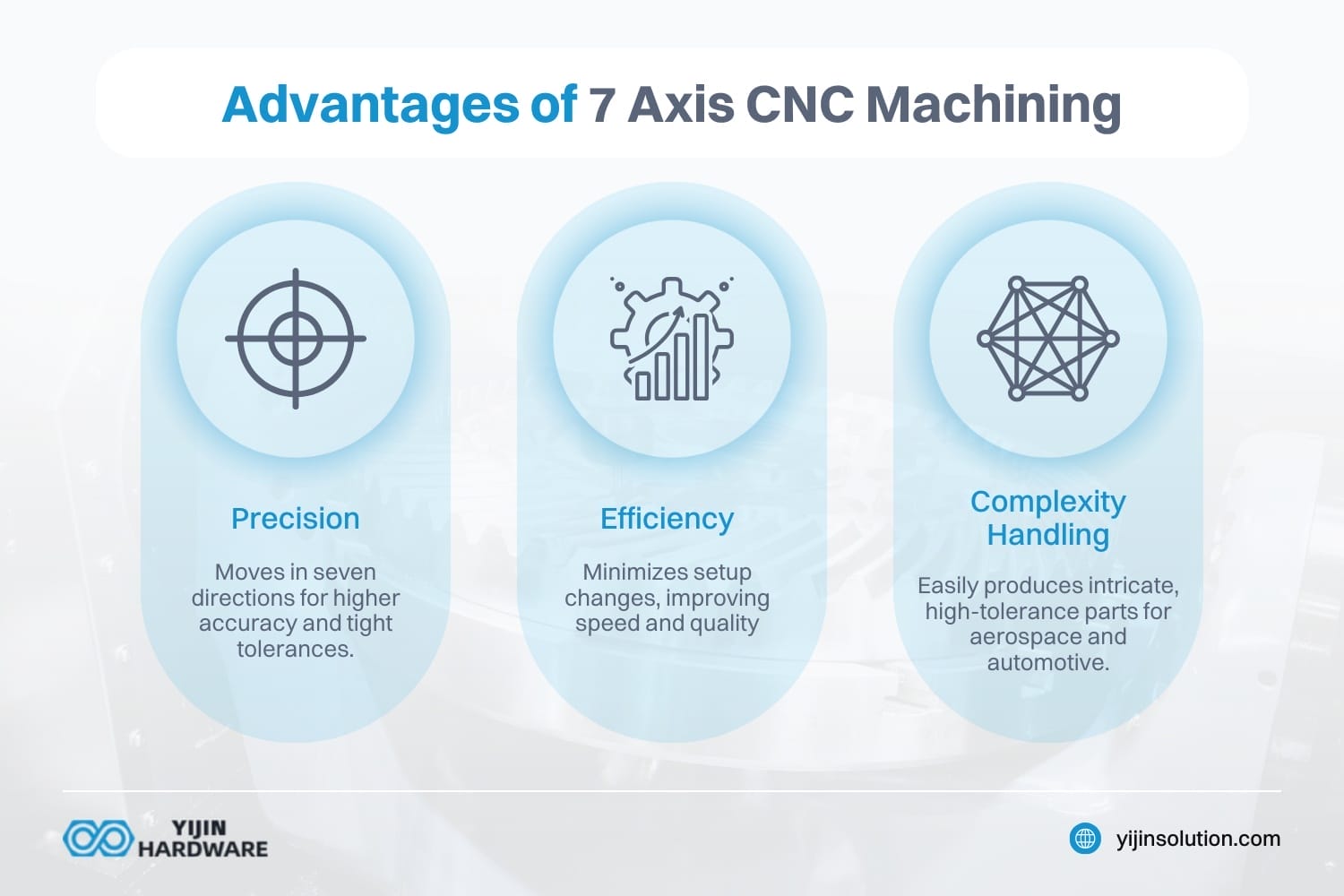
7-axis CNC machining offers several advantages over traditional CNC machining, including increased precision, reduced production time, and the ability to create elaborate geometries. This makes it ideal for industries requiring high-precision parts with intricate details.
Principaux avantages
- Précision: Achieves higher accuracy by moving the tool and workpiece in seven directions, allowing for tighter tolerances.
- Efficacité: Reduces processing time and improves quality by minimizing setup changes, which is particularly beneficial in high-volume production.
- Complexity Handling: Capable of handling intricate designs and tight tolerances with ease, making it suitable for complex parts in aerospace and automotive industries.
Yijin Hardware specializes in providing affordable and high-quality 7-axis CNC machining services. If you are looking for reliable 7-axis CNC machining, prendre contact with us today to explore how we can support your manufacturing goals.
FAQs on What is 7-Axis CNC Machining?
What is the cost of a 7-axis CNC machine?
A 7-axis machine is highly advanced and costs between $500,000 to $1,200,000. This price range reflects the sophisticated mechanical systems, advanced control electronics, and precision components required to maintain accuracy across all seven axes
How many axes can a CNC machine have?
A CNC machine can have anywhere from three to twelve axes. A 3-axis machine moves in X, Y, and Z directions but lacks rotational capabilities. The range of CNC machines includes multiaxis machining options for intricate designs. Higher-axis machines provide superior precision for demanding manufacturing applications.
How does 7-axis CNC machining impact production efficiency?
7-axis machining enhances production efficiency by reducing setup time and manual adjustments. A milling machine with seven axes can perform multiple operations in a single pass. Unlike a standard CNC milling machine, it allows more complicated cuts with fewer repositioning steps. This level of automation significantly boosts productivity in high-precision industries.
How does 7-axis CNC machining compare to additive manufacturing?
7-axis CNC machining and additive manufacturing (3D printing) represent fundamentally different approaches to component creation. 7-axis machining excels at producing high-precision parts from solid materials by removing material to create the final geometry, maintaining exceptional structural integrity and surface finish. It achieves tolerances as fine as ±0.0001” (0.00254 mm) with surface finishes below 0.4 μm Ra.
What are the programming challenges for 7-axis CNC machines?
Programming 7-axis CNC machines presents several significant challenges, requiring specialized expertise. Coordinating movement across seven simultaneous axes requires advanced CAM software with specific multi-axis capabilities, such as Autodesk PowerMILL, Mastercam, or proprietary systems. Collision avoidance becomes substantially more difficult with seven axes, requiring sophisticated simulation and verification processes to prevent tool, holder, and machine collisions during operation.
Retour en haut de la page : What is 7-Axis CNC Machining?




 FR
FR  EN
EN  ES
ES  RU
RU  DE
DE